


DHI vs Sapphire FUE: Which Hair Transplant is Right for You?
You have made the life-changing decision to restore your hair. You have researched the clinics, looked at the before-and-after photos, and perhaps even booked your flight to Istanbul.
DHI and Sapphire are two of eight methods, compared side by side here.
But now, you face the final and often most confusing hurdle: the “alphabet soup” of medical techniques.
DHI? Sapphire FUE? Classic FUE?
In our daily practice at Clinicana, the most common question we receive during consultations is: “Doctor, which one is better?”
Patients often assume that the most expensive option or the newest acronym must be the superior choice.
However, in medicine, there is rarely a “one size fits all” solution. The truth is that both Direct Hair Implantation (DHI) and Sapphire Follicular Unit Extraction (FUE) are world-class technologies.
The choice between them is not about which tool is “better,” but rather which tool is the right instrument for your specific pattern of hair loss.
Choosing a technique without a proper diagnosis is like choosing a prescription before seeing the doctor. This comprehensive guide is written to demystify the science behind these two leading methods.
We will break down the mechanics, the recovery timelines, the costs, and the ideal candidates for each, helping you make an empowered decision for your restoration journey in 2026.
The Core Difference: Tools & Methodology
To understand the comparison, we must first strip away the marketing and look at the mechanics of how the hair is actually implanted into your scalp.
What is Sapphire FUE? (The “Coverage King”)
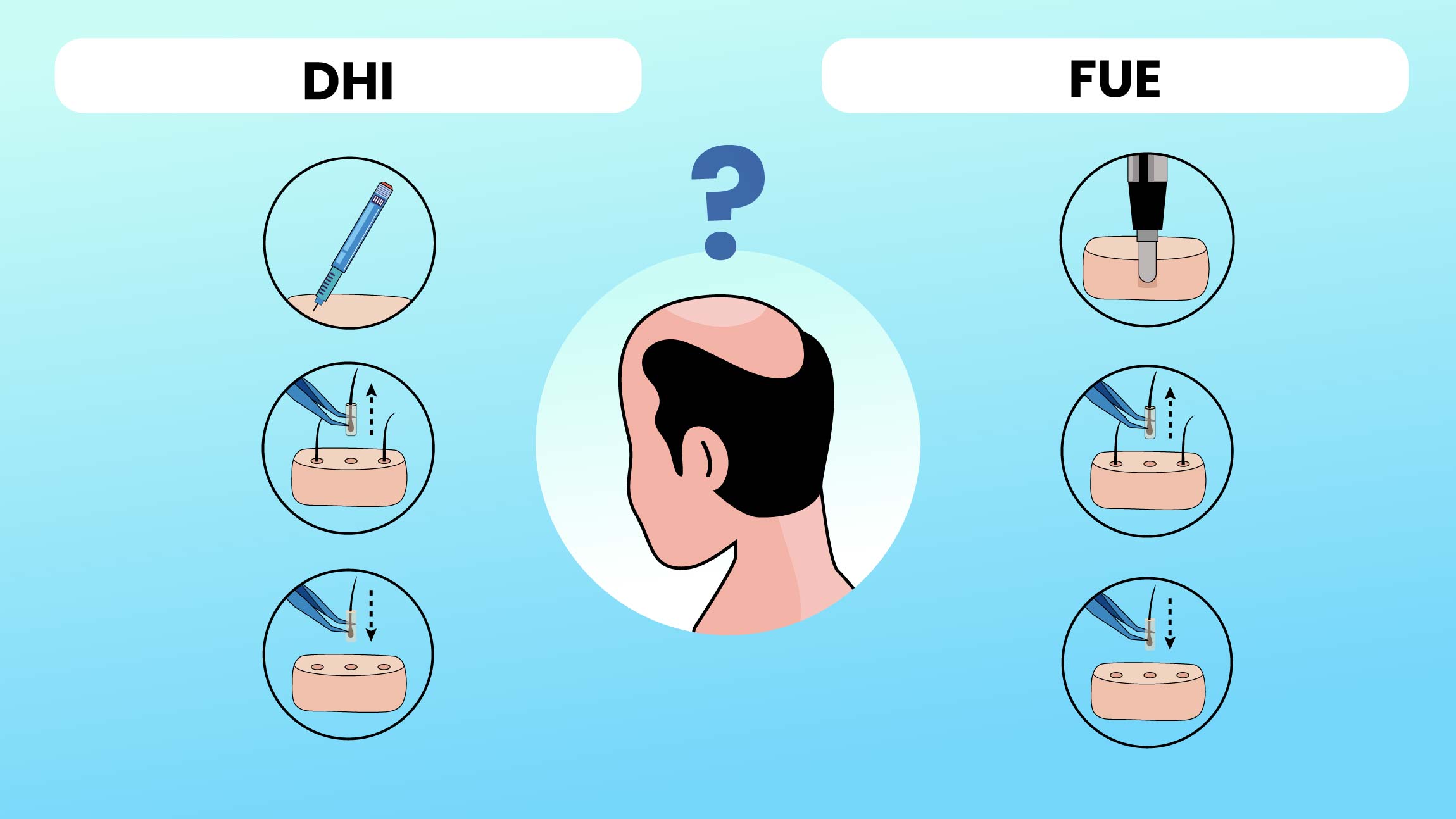
Follicular Unit Extraction (FUE) is the modern standard for harvesting hair. “Sapphire” refers to the specific tool used during the channel opening phase—the step where the surgeon creates tiny incisions in the recipient area to receive the grafts.
- The Innovation: Traditionally, surgeons used steel blades. However, steel can lose its sharpness over thousands of incisions, causing unnecessary tissue trauma. In Sapphire FUE, we use blades made from a single crystal of synthetic sapphire (Al₂O₃).
- The V-Shape Advantage: Sapphire blades are incredibly sharp and durable. They allow us to create V-shaped micro-channels rather than the U-shaped cuts made by steel.
- Why it matters: This precision minimizes tissue vibration and trauma. It allows the surgeon to place channels closer together, enabling higher density grafting on large, bald areas without compromising the skin’s blood supply.
What is DHI? (The “Precision Artist”)
Direct Hair Implantation (DHI) is a technique that modifies the implantation phase entirely.
- The Choi Implanter Pen: In a standard transplant, the surgeon cuts a channel, and a technician later places the graft into it with forceps. In DHI, we use a specialized tool called the Choi Implanter Pen. This is a hollow needle with a plunger mechanism.
- The “One-Step” Process: The hair graft is loaded gently into the hollow needle of the pen. The surgeon then inserts the pen directly into the scalp and depresses the plunger to implant the graft.
- Why it matters: The channel is opened, and the graft is implanted simultaneously. This eliminates the need to create pre-incisions. It gives the surgeon extreme control over the angle, depth, and direction of every single hair.
DHI vs. Sapphire FUE: Detailed Comparison Table
To help you visualize the operational differences, here is a breakdown of how these techniques compare in a clinical setting.
| Feature | Sapphire FUE | DHI (Choi Pen) |
| Primary Tool | Sapphire Blade (Gemstone) | Choi Implanter Pen (Hollow Needle) |
| Implantation Method | Two-Step: Channels opened first, grafts placed later. | One-Step: Channels opened and grafts implanted simultaneously. |
| Ideal Candidate | Large areas of baldness (Norwood 4–7). | Thinning areas, hairline touch-ups, women (Norwood 1–3). |
| Shaving Required? | Usually Yes (Full shave required for max density). | No (Can be done unshaven or with minimal shaving). |
| Max Grafts per Session | High (4,500 – 5,500+ grafts). | Moderate (2,500 – 3,500 grafts). |
| Procedure Duration | 6–8 Hours (Efficient for volume). | 8–10+ Hours (Labor intensive). |
| Bleeding & Trauma | Minimal (Sapphire reduces trauma vs steel). | Very Low (Pen seals the wound instantly). |
| Cost (2026 Avg) | Moderate (Best value for large coverage). | Higher (Due to equipment and team size). |
| Recovery Time | Fast (Scabs fall off in 10-12 days). | Very Fast (Less bleeding = faster surface healing). |
5 Key Factors to Help You Choose
When our medical board reviews a patient’s case, we look at five specific criteria to recommend the appropriate technique.
1. Do You Need to Shave Your Head?
This is often the deciding factor for patients concerned about social downtime.
- Sapphire FUE: Generally requires shaving the entire head (donor and recipient).
This is necessary because the surgeon needs a clear view of the scalp to open thousands of channels quickly and accurately without existing hair getting in the way. - DHI: Is the gold standard for “Unshaven” or “Long Hair” transplants. Because the Choi pen slides between existing hairs easily, we do not need to shave the recipient area.
This makes DHI the preferred choice for women or men who wish to keep their hairstyle during recovery.
2. Extent of Hair Loss (The Norwood Scale)
The volume of hair needed dictates the tool.
- Sapphire FUE: Is designed for volume. If you are a Norwood 5, 6, or 7 (significant baldness on top and crown), you need 4,000+ grafts to achieve coverage.
Sapphire allows us to open these thousands of channels efficiently in a single session.
Using DHI for this volume would take too long, potentially keeping the grafts out of the body for an unsafe duration. - DHI: Is the tool of choice for Norwood 1, 2, and 3. If you have a receding hairline but a full crown, or if you have diffuse thinning where we need to add density between existing hairs,
DHI offers the precision to navigate around your native follicles without damaging them.
3. Recovery and Healing Time
Both techniques offer significantly faster healing than older methods (like steel blades or strip surgery), but the biological process differs slightly.
- Sapphire Healing: The V-shaped sapphire blade creates a very clean, antimicrobial cut. This leads to less scabbing and a smooth surface healing (“epithelialization”) within 10–12 days.
- DHI Healing: Because there is no “empty” hole left waiting for a graft—the hair fills the hole the moment it is created—bleeding is minimal. Patients often report less post-operative edema (swelling) with DHI.
4. Duration of the Surgery
- Sapphire FUE: Is highly efficient. An experienced team can implant 4,000 grafts in roughly 6 to 8 hours. This efficiency is better for the patient’s comfort and ensures grafts spend minimal time outside the body (ischemia time).
- DHI: Is labor-intensive. It requires a larger team: one surgeon to implant and two assistants to constantly reload the pens. A 3,000-graft DHI surgery can take as long as a 5,000-graft Sapphire surgery.
5. Cost Differences in 2026
- Why DHI costs more: DHI is typically priced 20–30% higher than Sapphire FUE. This is not just a markup; it reflects the higher cost of the disposable Choi pens (a new set is used for every patient) and the need for a larger, highly specialized medical team to manage the loading and implanting process.
Which One Provides “Better” Density?
There is a common myth in hair restoration forums that DHI always provides better density. This is medically inaccurate.
- The Reality of Density: Density is determined by how closely the surgeon can pack the follicles together without compromising the blood supply (vascularity).
- Sapphire’s Strength: On a completely bald scalp, Sapphire FUE often allows for higher density than DHI. The sapphire blade is thinner than the DHI needle, meaning we can create more channels per square centimeter on bare skin.
- DHI’s Strength: DHI wins on density when preserving existing hair. If we used Sapphire blades on a thinning scalp, we might accidentally cut the roots of your native hair (shock loss). The DHI pen pushes native hair aside, allowing us to increase density safely in areas that are not completely bald.
Why Clinicana Uses Both Techniques in Istanbul
At Clinicana Hair Transplant Center in Istanbul, we do not favor one technique over the other. We view them as different paintbrushes for different parts of the canvas.
The “Combined” Approach (Hybrid)
In complex cases, we often use a Hybrid Protocol.
- Example: For a patient with a receding hairline (bare skin) and thinning mid-scalp (existing hair):
- We may use Sapphire FUE for the front hairline to create maximum density and sharp definition.
- We then switch to DHI for the mid-scalp and crown to densify the thinning areas without shaving or damaging the native hair.
This bespoke approach ensures you get the benefits of both worlds: the coverage of Sapphire and the delicate precision of DHI.
Medical Safety at Acıbadem Hospital
Regardless of the tool—Sapphire or DHI—the environment matters more. We perform all procedures within the world-class infrastructure of Acıbadem Taksim Hospital.
Whether we are using gemstones or implanter pens, your safety, sterilization, and anesthesia are managed under JCI-accredited hospital standards.
Frequently Asked Questions (FAQ)
Is DHI more painful than Sapphire FUE?
No. Both procedures are performed under local anesthesia, so you will feel no pain during the surgery. Post-operatively, DHI patients typically report slightly less soreness because there is less superficial bleeding, but the difference is minimal and easily managed with standard painkillers.
Can I get 5000 grafts with DHI?
It is technically possible but rarely recommended in a single session. Implanting 5,000 grafts with DHI would take 10-12 hours, which is exhausting for the patient and risky for the grafts (they may dry out).
For mega-sessions of 5,000+ grafts, Sapphire FUE is the safer and more effective medical choice. Alternatively, we can plan two DHI sessions over two days.
Which looks more natural?
Both techniques yield indistinguishable, natural results in the hands of an expert. Naturalness comes from the surgeon’s artistic ability to design the hairline, select the right single-hair grafts for the front row, and angle the implantation correctly. The tool is secondary to the artist’s hand.
Do I have to shave my head for Sapphire FUE?
Yes, for the best results, Sapphire FUE requires shaving. If you absolutely cannot shave, DHI is your only viable option.
Final Verdict: Get a Free Diagnosis from Clinicana Experts
Choosing between DHI and Sapphire FUE is not a decision you should make based on Google searches or pricing alone.
It requires a medical analysis of your donor capacity, your hair loss pattern, and your skin type.
Don’t guess with your health.
Your hair restoration journey begins with a proper diagnosis. Contact Clinicana’s medical team today. Send us your photos for a free, no-obligation medical assessment.
We will tell you honestly whether you are a candidate for the volume of Sapphire or the precision of DHI, ensuring your investment leads to the life-changing result you deserve.
Medical Disclaimer: This content is for informational purposes only and does not replace professional medical consultation.


Scalp psoriasis and seborrheic dermatitis are chronic inflammatory conditions that frequently cause discomfort, itching, redness, and scaling. For individuals experiencing hair thinning alongside these conditions, severe anxiety often arises regarding permanent follicle loss and the feasibility of hair restoration. A central concern among patients is whether undergoing a hair transplant while managing scalp psoriasis is […]
Medical Review by: Prof. Dr. Soner Tatlıdede – October 2026 Hair loss—specifically androgenetic alopecia (pattern baldness)—is driven by a progressive cellular process known as follicular miniaturization. Under the influence of dihydrotestosterone (DHT) and localized micro-inflammation, the growth phase (anagen) of the hair cycle shortens, while the resting phase (telogen) lengthens. Over successive hair cycles, blood flow to the […]
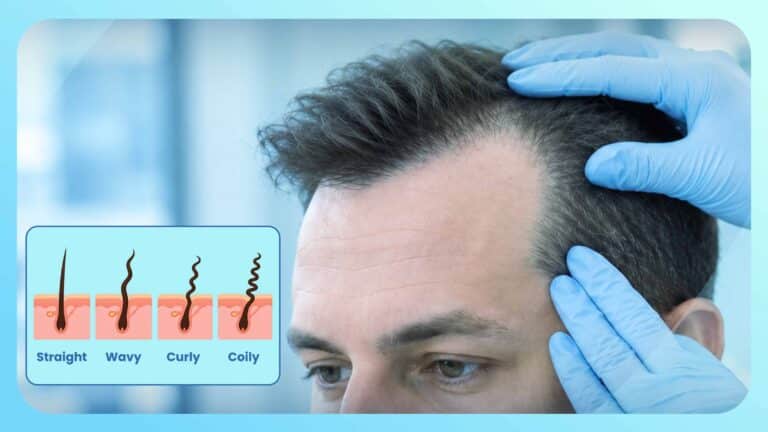
Medical Review by: Prof. Dr. Soner Tatlıdede – September 2026 Quick Summary (TL;DR) Hair types are globally categorized into four main classes—Type 1 (Straight), Type 2 (Wavy), Type 3 (Curly), and Type 4 (Coily/Afro-textured)—determined by the biological shape and exit angle of the hair follicle beneath the scalp surface. While straight hair grows from round, perpendicular follicles, […]


Thank you!
Your details have been successfully submitted. Thanks!