


Hair Loss After Radiation Therapy vs. Chemotherapy: Timeline, Scalp Care, and Hair Restoration Options
Medical Review by: Prof. Dr. Soner Tatlıdede – September 2026
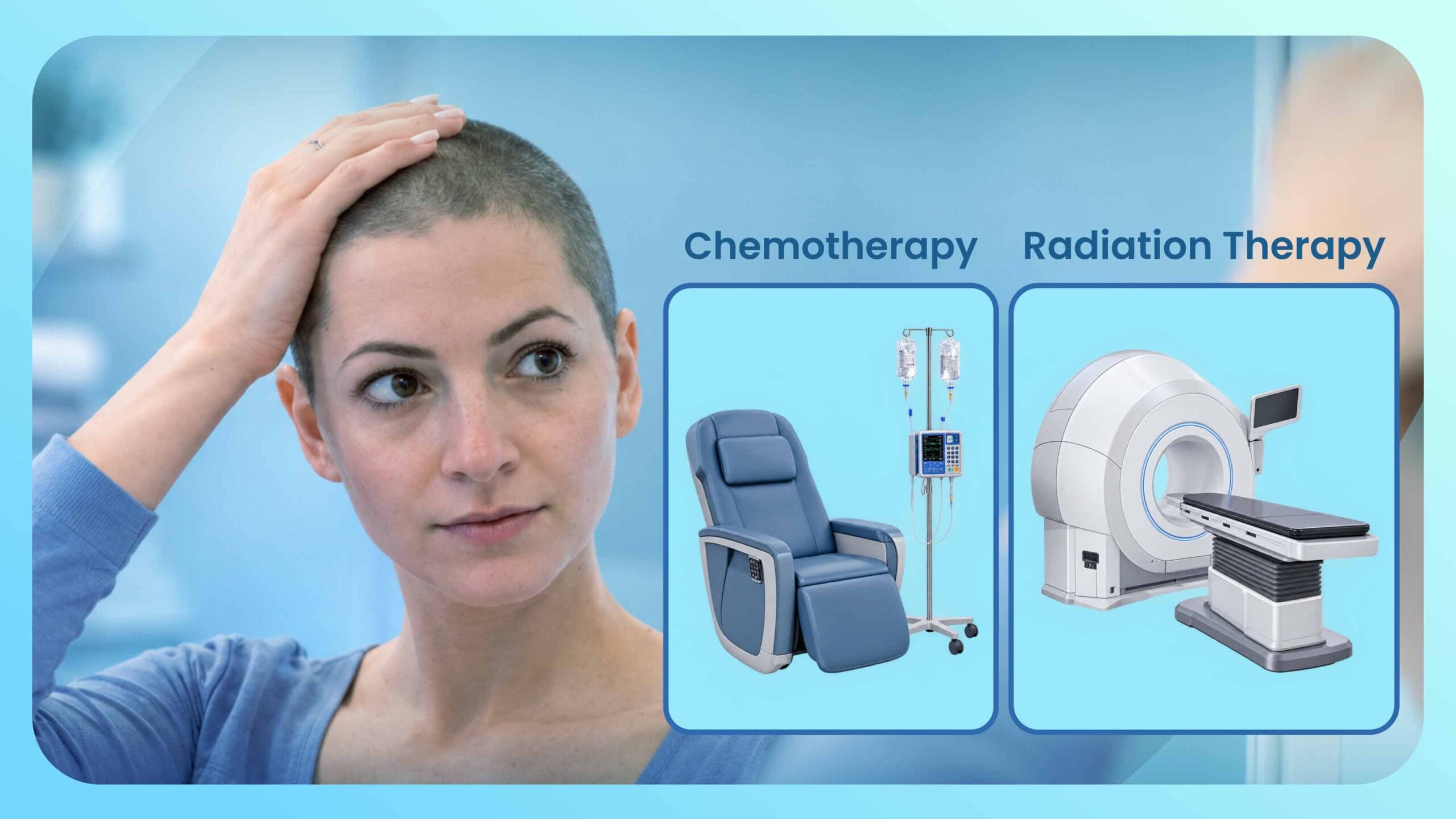
Undergoing cancer treatment brings significant physical and emotional challenges. Among the various side effects, hair loss (alopecia) remains one of the most distressed symptoms for patients.
However, a widespread misconception among patients and their families is that all cancer treatments affect hair growth in the exact same manner.
Many patients preparing for radiation therapy worry they will experience total body hair loss, similar to the effects of systemic chemotherapy.
Understanding the biological mechanisms behind Radiation-Induced Alopecia (RIA) versus Chemotherapy-Induced Alopecia (CIA) is essential for setting realistic expectations, managing scalp health during oncology treatment, and exploring potential post-recovery restoration options.
Radiation Therapy vs. Chemotherapy: Biological Mechanisms and Hair Loss Extent
To understand why hair loss varies between cancer treatments, one must look at how each modality targets cancer cells and impacts healthy, rapidly dividing non-cancerous cells—such as those within the hair follicle matrix.
Chemotherapy-Induced Alopecia (CIA)
Chemotherapy relies on systemic cytotoxic medications administered intravenously or orally. These drugs circulate throughout the entire bloodstream to target rapidly dividing cells.
Because hair follicle matrix cells are among the fastest-proliferating cells in the human body, systemic chemotherapy disrupts the hair growth cycle globally. This results in hair shedding across the entire scalp, face (eyebrows and eyelashes), and body.
Radiation-Induced Alopecia (RIA)
Radiation therapy uses localized ionizing radiation (high-energy X-rays, gamma rays, or protons) aimed precisely at a targeted anatomical region containing the tumor.
Consequently, radiation-induced hair loss is strictly localized. Hair loss occurs only within the precise field or path through which the radiation beams enter and exit the body.
- If radiation is targeted at the pelvis, chest, or abdomen, scalp hair remains entirely unaffected.
- If high-dose radiation is targeted directly at the brain or head and neck region, hair loss occurs specifically on the areas of the scalp or face situated within the radiation field.
Comparison Overview
Radiation Dosage and Permanence: Temporary vs. Permanent Alopecia
Unlike chemotherapy, where hair regrowth is almost guaranteed once the body clears the medication, radiation therapy can cause either temporary or permanent hair loss. The primary deciding factor is the cumulative dose of radiation, measured in Grays (Gy), delivered to the tissue.
Temporary Hair Loss (Anagen Effluvium)
When follicular tissues receive lower doses of radiation (typically under 30 to 45 Gy), the radiation temporarily halts the mitotic activity of the hair matrix cells.
This sudden arrest forces hair follicles into an abrupt resting phase, causing hair shafts to break or shed. Once radiation cycles conclude, the stem cells within the bulge region of the hair follicle usually recover, allowing hair regrowth to begin within 3 to 6 months.
Permanent Hair Loss (Radiation Fibrosis)
When cumulative localized doses exceed 45 to 50 Gy (often required for primary brain tumors or deep-seated head and neck malignancies), the ionizing energy causes permanent structural damage. High-dose exposure leads to microvascular destruction, tissue ischemia, and severe follicular atrophy.
The biological repair mechanism replaces damaged hair follicles with fibrotic scar tissue—a condition known as post-radiation scarring alopecia. In these high-dose areas, hair will not regrow naturally.
3. Timeline of Radiation-Induced Hair Loss and Regrowth
Understanding the clinical timeline helps patients navigate the physical stages of treatment with confidence.
- Initiation (Weeks 2 to 3): Hair shedding typically begins two to three weeks after the first radiation session within the targeted treatment field.
- Peak Loss (Weeks 4 to 6): As cumulative dose accumulates, complete localized hair loss within the radiation zone occurs.
- Resting Phase (1 to 3 Months Post-Treatment): After radiotherapy finishes, the scalp needs time to recover from acute radiation dermatitis (redness, dryness, flaking).
- Regrowth Window (3 to 6 Months Post-Treatment): If radiation doses remained below permanent atrophy thresholds, new, fine hair strands begin to emerge. The new hair may initially differ in texture, color, or density compared to pre-treatment hair.
- Final Evaluation (12+ Months Post-Treatment): By one year after completing therapy, hair regrowth stabilizes. Any remaining hairless patches within the radiation field are generally considered permanent scarring alopecia.
Scalp Care Guidelines During and After Radiation Therapy
Radiation dermatitis is a frequent side effect of localized radiotherapy to the head and neck. Maintaining mild, non-irritating scalp care is crucial for preventing infection and supporting healthy healing.
Recommended Scalp Care Practices
- Use Ultra-Mild Cleansers: Wash the scalp gently with lukewarm water and mild, fragrance-free, pH-neutral or organic baby shampoos.
- Avoid Friction: Pat the scalp dry gently with a soft towel; never rub or scrub vigorously.
- Sun Protection: Radiated skin is extremely susceptible to ultraviolet damage. Wear loose-fitting, soft cotton caps or use broad-spectrum physical sunscreens if approved by your radiation oncologist.
- Apply Approved Emollients: Use moisturizers or barrier creams only as specifically prescribed by your oncology team to soothe dry, itchy, or peeling skin.
Practices to Avoid
- Harsh Chemicals: Avoid hair dyes, perms, styling gels, or alcohol-based lotions during treatment and for at least six months post-treatment.
- Thermal Damage: Do not use blow dryers, straighteners, or hot water on the irradiated scalp area.
- Mechanical Strain: Avoid tight hats, hairpieces with aggressive adhesives, or vigorous scalp massages while the skin is active or healing.
Hair Transplantation Post-Cancer Recovery: Safety and Candidacy
For cancer survivors left with permanent localized hair loss, hair restoration surgery offers a path toward regaining pre-treatment appearance and self-confidence. However, performing hair transplantation on post-radiated skin requires extreme clinical caution.
Clinical Pre-Requisites for Hair Transplantation
Hair transplantation—using advanced techniques such as Sapphire FUE (Follicular Unit Extraction) or DHI (Direct Hair Implantation)—can successfully restore density in areas of post-radiation alopecia under strict surgical conditions:
- Complete Cancer Remission: The patient must be fully cleared by their primary oncologist, with zero evidence of active malignancy.
- Time Elapsed: A minimum waiting period of 12 to 24 months following the completion of radiation therapy is mandatory to ensure tissue stability and microvascular recovery.
- Oncology Clearance: Written medical clearance from the treating oncologist is required prior to any surgical hair restoration procedure.
- Assessment of Tissue Vascularity: Irradiated skin often exhibits reduced blood supply (hypovascularity) and fibrosis. A specialized hair transplant surgeon must evaluate whether the dermal bed can support transplanted hair grafts.
Specialized Surgical Approach: Sapphire FUE & DHI
At specialized clinics like Clinicana, post-cancer patients undergo comprehensive evaluations:
- Micro-Incision Precision: Techniques like Sapphire FUE utilize ultra-sharp sapphire blades to create precise micro-channels, minimizing extra trauma to delicate, post-radiation scalp tissues.
- Direct Graft Placement: DHI allows direct control over implantation angle, depth, and placement speed, which helps protect graft survival rates in compromised skin beds.
- Conservative Density Planning: Because irradiated tissue has altered microcirculation, surgeons may recommend lower graft density per session or staged procedures to ensure optimal vascular nourishment for every transplanted follicle.
Conclusion & Next Steps
Hair loss from radiation therapy is fundamentally distinct from chemotherapy-induced alopecia. While chemotherapy causes temporary, body-wide hair loss, radiation therapy leads to localized hair loss strictly limited to the treatment field—which may be temporary or permanent depending on the total dose administered.
If you have completed your cancer recovery and are left with localized permanent hair loss, professional evaluation can help determine if you are a candidate for restorative surgery. Contact Clinicana today to schedule a confidential medical consultation, review your medical history, and explore safe, individualized hair restoration options with our clinical specialists.
Academic References
- Severs, G. A., & Griffin, T. (2018). Radiation-Induced Alopecia: Pathophysiology, Dose Thresholds, and Clinical Management. Journal of Clinical and Aesthetic Dermatology, 11(4), 22–29.
- Aite, C., & Tosti, A. (2020). Chemotherapy-Induced vs. Radiation-Induced Hair Loss: Mechanisms, Patterns, and Recovery Timelines. Dermatologic Clinics, 38(1), 105–117.
- Lawton, N. E., et al. (2019). Post-Radiation Scarring Alopecia and Tissue Viability for Surgical Hair Restoration. Archives of Dermatological Research, 311(8), 611–620.
- Belum, V. R., et al. (2016). Efficacy and Safety of Hair Restoration in Cancer Survivors: A Systematic Review. Supportive Care in Cancer, 24(7), 3183–3194.


Medical review by: Prof. Dr. Soner Tatlıdede, hair transplant surgeon (22+ years, 18,947 procedures) – October 2026 When can you cut your hair after a hair transplant? Hair in the donor area can be trimmed after 1 month using scissors or clippers. As for the recipient area, trimming only the ends of the hair using […]

Medical review by: Prof. Dr. Soner Tatlıdede, hair transplant surgeon (22+ years, 18,947 procedures) – October 2026 Congratulations on completing your hair transplant. While the surgical part is finished, the success of your restoration now depends heavily on the recovery phase. In our clinical experience, the first two weeks post-surgery are just as critical as […]
Scalp psoriasis and seborrheic dermatitis are chronic inflammatory conditions that frequently cause discomfort, itching, redness, and scaling. For individuals experiencing hair thinning alongside these conditions, severe anxiety often arises regarding permanent follicle loss and the feasibility of hair restoration. A central concern among patients is whether undergoing a hair transplant while managing scalp psoriasis is […]


Thank you!
Your details have been successfully submitted. Thanks!