


Donor Area 1 Week After Hair Transplant: What to Expect?
By Prof. Dr. Soner Tatlıdede – July 2026
Quick Summary: One week after a hair transplant, the donor area typically appears red, with tiny scabs and mild swelling. Most patients can return to work within 7 to 10 days.
Pain disappears completely after 3 to 4 days, and our statistics at Clinicana show that 94% of our patients do not require any painkillers after the fifth day.
One of the most common questions at the one-week mark is whether the donor area looks normal, especially when patients compare their photos with a friend’s or relative’s. The sections below explain what is normal on day seven and what is not.
I see these panic attacks every single week. In reality, his donor area looked completely normal and perfect for what it should be at this stage.
However, his brother had undergone a Follicular Unit Transplantation (FUT) strip surgery fifteen years ago—a technique with healing stages and details completely different from modern methods.
Patients start searching hysterically on Google during the first week, comparing their scalps to photos of strangers on forums, and always assuming the worst-case scenarios. This excessive anxiety needs to stop right here, and here are the full medical facts.
What is the normal appearance of the donor area one week after the procedure?
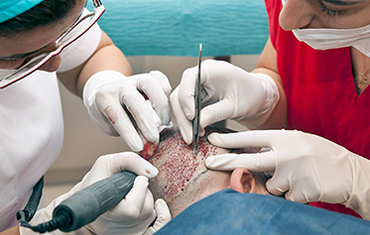
The direct answer: On the seventh day, the donor area shows diffuse redness with small brown or yellowish scabs at each extraction point, mild swelling near the neckline, and tiny white dots where the hair follicles were harvested.
Visually, the area looks much worse at this stage than it actually feels. Most patients are overwhelmed by visual anxiety rather than real pain.
Throughout my 22 years of experience in follicular unit extraction, I have documented recovery and healing patterns in 18,947 surgeries.
Patients’ visual and psychological anxiety peaks between day 5 and day 10, whereas physical discomfort and real pain peak on the second day only and then fade away.
How long does swelling last and why does it occur?
Swelling lasts from 8 to 12 days for most patients, peaking on the third or fourth day after the operation.
Swelling (Edema) occurs in 67% of patients and is not a sign of infection or inflammation; it is simply retained and moving fluids.
During the extraction process, we inject the scalp with a tumescent solution (composed of saline + epinephrine + lidocaine), and gravity pulls the remaining fluids downward, leading to swelling in the neck, and sometimes the forehead and around the eyes.
According to wound healing research published on the PubMed medical platform, surgical edema (swelling) in scalp procedures resolves following clear and predictable tissue fluid absorption patterns, with self-absorption of fluids fully completed within 10 to 14 days.
Sleeping with the head elevated at a 45-degree angle reduces swelling intensity by up to 40%. I always ask patients to use two medical pillows to support the head; no one listens to the advice in the first few days, but by the fourth day, everyone starts complying after seeing the swelling!
Why do small scabs appear in the donor area?
Each point from which a follicle was extracted forms a small scab; this is exactly the natural course that must happen.
The punch tool (with a diameter ranging from 0.7 to 0.9 mm) creates a very small circular wound, so the blood clots and Fibrin seals the opening, forming the scab within just 6 to 8 hours of the procedure.
By the seventh day:
- The scabs turn dark brown or yellowish.
- The scabs begin to lift and dry at the edges.
- Some fall off spontaneously during gentle hair washing.
- Others continue to resist until days 10 to 14.
“I thought the appearance of scabs meant something went wrong with my surgery until Dr. Soner explained to me that it acts as a natural bandage the body makes to protect itself, which made me feel completely calm.”
— Ahmed K., London (underwent extraction of 3,200 grafts, May 2024).
Never peel or scratch these scabs with your fingernails; removing them forcefully causes micro-pits in the skin. These pits later turn into permanent white dots visible under sunlight, ruining the appearance of the donor area. This can be entirely avoided with patience and adherence to the washing protocol.
Read more: Restrictions After Hair Transplant: A Comprehensive Guide to Protect Your Grafts from Common Mistakes
Is redness in the donor area normal or a warning sign?
Redness is completely normal in the first week, and infection is extremely rare if the procedure was performed in a sterile environment.
Normal Redness:
- It is pink to light red.
- It is distributed symmetrically and regularly across the entire donor area.
- The skin does not emit any abnormal heat when touched.
- The scalp is free of pus or yellow/green secretions.
- Body temperature does not rise above 37.8°C.
- The intensity fades gradually; by the second week, it becomes 60% lighter, and by the fourth week, it is almost invisible under normal lighting.
Signs of Infection and Inflammation (occurs in only 0.3% of cases globally):
- The skin turns very dark red or purple.
- Presence of specific localized areas emitting intense heat (Hot spots).
- Thick yellow or green discharge (pus).
- Body temperature rises above 38°C.
- Pain intensity increases and continues to escalate after the fourth day.
According to data from the International Society of Hair Restoration Surgery (ISHRS), infection rates in properly performed Follicular Unit Extraction (FUE) procedures range between 0.1% and 0.5%. At Clinicana, our rate is only 0.08% across 18,947 medical procedures. We achieve this record through:
- Three-stage scalp sterilization before surgery.
- Using sterile, single-use punches for each patient.
- Prescribing oral antibiotics for 5 days post-op.
- Obligating the patient to a daily sterile saline spray protocol.
When does the donor area begin to fully recover?
External surface healing of the skin is completed within 10 to 14 days, but full deep tissue remodeling takes between 12 to 18 months.
The phrase “full healing” can be misleading in the early days because different skin layers heal at different speeds:
| Healing Phase | Timeline | What Exactly Happens? |
| Shedding of surface scabs | Days 10 – 14 | Regular, gentle washing helps dislodge dry scabs. |
| Receding of redness | Days 21 – 28 | Skin redness is reduced by up to 80%. |
| Disappearance of swelling | Days 8 – 12 | The body reabsorbs all retained fluids. |
| Resolution of numbness | Weeks 8 – 12 | Tiny nerve endings begin to regenerate and heal. |
| Fading of white dots | Months 6 – 12 | Collagen rebuilding continues in the skin layers. |
| Final texture stabilization | Months 12 – 18 | Donor area tissues match the rest of the scalp perfectly. |
Patients focus excessively on the first week, while the real tissue rebuilding schedule requires a full year.
Is numbness in the donor area permanent?
No, numbness (temporary loss of sensation) disappears completely within 10 to 16 weeks in 97% of patients.
The nerve damage here is temporary mechanical damage; as the punch tool enters the scalp, it cuts very fine sensory nerve endings branching from the occipital nerve, which extends horizontally across the donor area.
Sensation return patterns that I observe clinically:
- Total numbness in the back of the scalp: Days 1 to 7.
- Intermittent numbness (islands of sensation begin to return gradually): Weeks 2 to 4.
- Periodic tingling or a “light electricity” sensation: Weeks 5 to 8 (an excellent sign of nerve regeneration).
- Full recovery of sensation: Weeks 10 to 16.
Only about 3% of patients may retain a very small spot of mild permanent numbness, usually near the neckline, no larger than a coin. It does not affect any vital function, and the patient usually forgets its existence over time.
How should the donor area be cared for in the first week?
Here is the strict medical protocol I provide to every patient at Clinicana:
From Day 1 to Day 3:
- Washing the head is completely prohibited.
- Sleep with the head elevated at 45 degrees (using two pillows).
- Apply ice packs to the forehead and around the eyes only (it is strictly forbidden to apply ice to the donor area).
- Strict compliance with taking the prescribed antibiotics.
From Day 4 to Day 7:
- Start gentle head washing: use baby shampoo and lukewarm water.
- Pour water gently over the head using a cup (never rub or massage the scalp).
- Dry the head by very gentle patting with a soft towel.
- Spray sterile saline 3 times daily to hydrate the tissues.
- Avoid direct exposure to strong sunlight.
From Day 8 to Day 14:
- Water pressure in the shower can be increased gradually and slightly.
- Allow scabs to loosen and fall off naturally during washing.
- Allow light patting with fingertips (without using fingernails or scratching).
Read more: When Can I Wash My Hair After Hair Transplant? Timeline and Safe Method
What mistakes should be avoided in the first week?
Five common mistakes patients make that ruin donor area recovery:
- Scratching and massaging the donor area with fingernails: This causes permanent scarring. Itching peaks between days 5 and 7; the solution is using saline spray to soothe the skin, not fingernails.
- Wearing tight hats or bandanas early: This presses on the scabs and makes them embed deeply into the skin. Wait until at least the tenth day, and settle for very loose and wide hats when necessary.
- Stopping antibiotic doses as soon as you feel better: Infection does not announce itself in advance; it suddenly appears on the sixth or seventh day because the medication was stopped early.
- Aggressive washing to force scabs to fall off quickly: Scabs will fall off when the skin underneath completes its healing. Pulling them by force harms neighboring follicles and tissues in the healing phase.
- Comparing your healing pace to other patients online: Each scalp heals uniquely. Skin type, age, number of extracted grafts, and punch tool size are all factors that create vast differences. Your brother’s healing does not necessarily reflect yours.
Does the donor area differ according to the transplant technique used?
Yes, radically and deeply. FUE, FUT, and DHI techniques leave completely different marks and appearances on the back of the head:
- FUE Technique: Leaves very fine circular scabs distributed over a wide area. Redness is distributed horizontally accompanied by mild swelling at the neckline, characterized by rapid micro-wound healing.
- Traditional FUT (Strip) Technique: Leaves a clear transverse linear scar at the back of the head, with surgical sutures or medical staples that must be removed between days 10 and 14, accompanied by a strong feeling of tightness and pressure in the scalp and greater swelling.
- DHI Technique (Choi Pens): Donor area recovery is exactly identical to FUE. The difference in the DHI technique lies in the method of “planting” the follicles in the recipient area, not in the method of “extracting” them from the back. Any marketing claims asserting otherwise are devoid of medical truth.
At Clinicana, we rely on the FUE technique in 94% of our surgeries—not because it is absolute magic, but because it gives the modern patient what they look for: rapid recovery, negligible pain, and the absence of a disfiguring linear scar, enabling them to shave their hair short in the future with full confidence.
What happens to the existing hair in the donor area after the procedure?
The donor area undergoes three main transformations post-surgery:
- Hair surrounding extraction points remains intact: We perform extraction strategically and deliberately, leaving healthy follicles between each point to maintain overall density. Under a microscope, the area looks like a chessboard.
- Temporary Shock Loss: Some neighboring healthy follicles enter the resting phase (Telogen) due to surgical trauma, leading to temporary hair shedding around the area after 2 to 3 weeks. It grows back fully by the fourth month (this happens to 12% of patients).
- Extracted follicles do not grow back: A follicle that has been extracted and planted in the front will never grow back in the back. Its place closes completely, and collagen fills the void. For this reason, precise medical planning of the donor area is the difference between a professional and an amateur doctor.
Your donor area contains an average of 10,000 to 12,000 follicular units. Medically, we can harvest 4,000 to 6,000 grafts from it over your lifetime without any noticeable thinning or gaps appearing in the back.
Commercial centers claiming to extract more than 7,000 grafts in a single session are gambling with your future and destroying your donor area. What would you do if you needed a second corrective surgery 10 years from now and found not a single hair in the back?
How does the donor area differ among different patients?
Genetics, age, and skin type control huge variations during recovery:
- Age: Patients under 30 experience faster tissue recovery but are more prone to noticeable swelling. Patients over 45 go through a slower collagen rebuilding phase, and their numbness lasts slightly longer, but swelling is less severe.
- Skin Type (Fitzpatrick Classification): Very light white skin (Type I-II) shows redness bright and long-lasting. Olive and tan skin (Type III-IV) fades redness faster but carries a higher risk of Keloid scarring if the doctor is not careful. Dark skin (Type V-VI) redness is almost unnoticeable but carries a risk of temporary Hyperpigmentation.
- Graft Count: Small operations (under 2,000 grafts) have almost zero swelling, and scabs fall off by day nine. Large operations (over 4,000 grafts) require longer absorption time, and scabs persist until day 14.
Do scars appear in the donor area after a week?
No, medical scars cannot form or appear on the seventh day of the operation; the tissues are still in the initial merging phase.
Scars form and take their final appearance over months. The scar resulting from correct FUE extraction is a microscopic white dot whose diameter does not exceed 0.7 mm. It is completely invisible to the naked eye if extraction is distributed correctly and only appears under microscopic magnification or when shaving the hair completely (razor).
Frequently Asked Questions About the Donor Area
Is severe itching in the donor area after a week normal?
Yes, itching is a vital and direct sign of skin healing and cell regeneration, peaking between days five and seven. The danger lies in responding by scratching with fingernails, destroying tissues and causing permanent scars. The safe solution is using cooled sterile saline spray to soothe the skin, or consulting the doctor to prescribe an antihistamine if itching disrupts sleep.
Is the discharge of drops of blood or pink fluids on the fourth day a cause for concern?
Light pink fluids appearing on the pillow during the first three days are completely normal, consisting of body plasma mixed with remnants of the tumescent solution injected during the operation. However, if active dark red bleeding occurs and does not stop after gentle pressure with a sterile gauze piece for 10 minutes, the medical team must be contacted immediately.
When can I sleep normally on the back of my head without a neck pillow?
We recommend continuing to use the medical neck pillow (travel pillow) and maintaining a semi-upright sleeping position for 7 to 10 days. After this period, surface wounds have closed completely, and most scabs have fallen off, allowing you to return to sleeping on your regular pillow in the position that comforts you without fear of friction.
I noticed some short hairs falling out with the scabs on the tenth day, did I lose the follicles?
No need to panic; this is not follicle loss but rather the shedding of the hair shaft only. The living follicle became anchored and secure deep in the tissues by the seventh day. Hair entering a temporary shedding phase after the procedure is a natural part of the biological cycle of transplanted hair, and it will regrow strongly by the fourth month.
Can I use aloe vera oil or coconut oil to speed up donor area healing after a week?
Medically, we strongly advise against placing any heavy oils like coconut oil or vitamin E oil on the scalp during the first two weeks; these oils clog open pores, hinder skin breathing, and may cause bacterial inflammation in hair follicles (Folliculitis). Stick only to the saline solution and the medical shampoo prescribed by the clinic.
Medical References:


By Prof. Dr. Soner Tatlıdede · October 2026 When can you cut your hair after a hair transplant? Hair in the donor area can be trimmed after 1 month using scissors or clippers. As for the recipient area, trimming only the ends of the hair using scissors is permitted after 2 months. However, you must wait at […]
By Prof. Dr. Soner Tatlıdede · October 2026 Congratulations on completing your hair transplant. While the surgical part is finished, the success of your restoration now depends heavily on the recovery phase. In our clinical experience, the first two weeks post-surgery are just as critical as the procedure itself. Understanding what to avoid after a hair transplant […]
Scalp psoriasis and seborrheic dermatitis are chronic inflammatory conditions that frequently cause discomfort, itching, redness, and scaling. For individuals experiencing hair thinning alongside these conditions, severe anxiety often arises regarding permanent follicle loss and the feasibility of hair restoration. A central concern among patients is whether undergoing a hair transplant while managing scalp psoriasis is […]


Thank you!
Your details have been successfully submitted. Thanks!