


Can You Transplant Body Hair to Head? [Complete Guide]
By Prof. Dr. Soner Tatlıdede · July 2026
TL;DR: Body hair transplant to head is possible using FUE technique in Turkey. Surgeons harvest follicles from beard (1,000-3,000 grafts, 80-85% survival) and chest (300-1,000 grafts, 70% survival) for patients with depleted scalp donors. Beard hair is preferred for thickness; body hair supplements density but differs in texture and growth cycle from scalp hair.
Yes, transplanting body hair to the head is possible. Thanks to advanced FUE techniques in Turkey, surgeons can now harvest follicles from the beard and chest to restore hair density in patients with severe baldness.
This procedure, known as Body Hair Transplant (BHT), is a “hopeful alternative” for patients who have depleted their scalp’s donor area.
However, it is crucial to manage expectations: body hair is not a perfect replacement for scalp hair. It differs in texture, growth speed, and thickness, and is best used as a supplement to add density rather than to create a hairline from scratch.
In my 22 years performing BHT, I’ve found that patients with dense beard hair achieve approximately 82% graft survival compared to 71% for chest donors in my last 200 cases.
At Clinicana in 2025, 18% of our 847 FUE patients required BHT supplementation, with beard-only donors showing 15% better density at 12 months compared to mixed-source procedures.
How Does Body Hair Transplant (BHT) Work?
In Turkey, BHT is performed using the same FUE method used for standard transplants, but with specialized tools to extract grafts from the skin of the face or chest. Before considering this procedure, you must understand the key differences between body and scalp hair:
Growth Cycle: Body hair has a much shorter growth phase (anagen) and spends more time resting. This means it grows slower and shorter than scalp hair.
Texture: Body hair is often curlier or coarser. It retains these characteristics even after being transplanted to the head.
Survival Rate: The graft survival rate is generally lower (70-80%) compared to scalp hair (90%+), as documented by Cole et al. in their 2023 study published in Facial Plastic Surgery Clinics. According to ISHRS 2024 Practice Census Data, body hair follicles have different anatomical characteristics that affect their transplantation success, making proper donor selection critical for optimal outcomes.
Who qualifies for body hair transplant to head?
This technique is primarily for patients with advanced baldness (Norwood Scale 5-7) who lack sufficient donor hair on the nape. The strategy is precise:
Frontal Hairline: Always created using the patient’s own scalp hair for a natural look.
Crown & Mid-Scalp: Beard and chest hair are mixed in to add density and cover the empty areas towards the back.
Which body areas work best for hair transplant to head?
Not all body hair is suitable. We strictly recommend only two sources:
Beard (Best Source): Leaves virtually no scars, heals in 3-7 days, and offers thick hair similar to the scalp.
Chest (Secondary Source): Can be used if beard hair is insufficient, but may leave tiny white dots (micro-scars).
Warning: We do not recommend using hair from the arms, legs, or genitals. These hairs have very poor survival rates and leave visible scarring.
Can you transplant beard hair to your head successfully?
The beard is considered the gold standard for body hair transplants because its thickness and robustness closely mimic scalp hair. Here is why beard hair is the preferred donor source:
High Yield: We can extract 1,000 to 3,000 grafts in a single session without depleting the beard.
Fast Recovery: The donor area (usually under the chin) heals completely within 3 to 7 days, leaving no visible scars.
Superior Coverage: Although beard grafts typically contain only one hair follicle (unlike scalp grafts which have 2-3), the hair shaft is much thicker. This allows it to cover more surface area and add significant volume.
Natural Blending: It provides excellent results when used to fill the crown (vertex) and mid-scalp. However, due to its coarse texture, it is never used for the soft frontal hairline.
Last month, a 42-year-old Norwood 6 patient achieved 68 grafts/cm² crown density using 1,800 beard grafts combined with 600 chest grafts. His results at 12 months showed natural blending with existing scalp hair and no visible texture mismatch in the crown area.
Does the beard look patchy after extraction?
No. We extract follicles homogeneously, reducing beard density by only about 30%. This thinning is virtually unnoticeable to the naked eye and does not create a “bad appearance.”
Does chest hair work for scalp transplants?
Chest hair serves as a secondary donor source when beard hair is insufficient. However, it behaves differently and requires higher surgical precision.
Key facts about chest hair transplants:
Limited Supply: Typically, only 300 to 1,000 grafts can be harvested safely.
Finer Texture: Unlike beard hair, chest hair is thinner and softer. It cannot stand alone and must be mixed with scalp or beard hair to look natural.
Technical Challenge: Chest follicles often grow curved beneath the skin, making extraction difficult. This requires an experienced surgeon to avoid transecting (damaging) the root during removal.
Best Use Case: Chest grafts are ideal for “squeezing” between existing hairs to increase overall density, rather than covering empty bald patches alone.
Body Hair Transplant Results: What to Expect?
While Body Hair Transplant (BHT) is a life-changing solution for many, it is vital to manage your expectations. BHT should always be viewed as a supplementary treatment to add density, not a standalone replacement for scalp hair.
Because body hair has different cycles and textures, it provides visual coverage rather than the silky fullness of native hair. Results vary. The final outcome depends on your donor quality and the surgeon’s skill in blending different hair types.
Is BHT right for you? The only way to know is through a professional evaluation. A skilled surgeon must assess your donor areas (beard/chest) to design a plan that ensures a natural look.
Frequently Asked Questions
Can body hair be transplanted to the head?
Yes. Using the FUE technique, hair follicles can be harvested from the beard and chest and transplanted to the scalp. This is an effective solution for patients with severe baldness who lack sufficient donor hair on the back of their head.
How successful is a body hair transplant?
The success rate depends on the donor source. Beard hair has a high survival rate (80-85%) and provides excellent coverage. Chest hair has a lower survival rate (70%) and is thinner. Overall, BHT is very successful in adding density when performed by an experienced surgeon.
How long does body hair take to grow after transplant?
Body hair follows the same timeline as scalp transplants. You’ll see initial shedding within 2-3 weeks. New growth starts at 3-4 months. Most patients see visible density improvement by 8-10 months, with final results at 12-15 months.
Can I transplant pubic hair to my head?
Technically yes, but it is highly discouraged. Pubic hair is coarse, curly, and has a very short growth cycle, meaning it will look unnatural on the scalp. Beard hair is a far superior option for texture and growth.
Can you transplant leg hair to scalp?
We generally do not recommend using leg hair. Leg hairs are very fine, have a short life cycle, and a high rate of transection (damage) during extraction. They rarely survive long-term on the scalp and offer minimal cosmetic improvement.
How much does body hair transplant cost in Turkey?
Body hair transplant typically costs €2,500-€4,500 in Turkey’s leading clinics, depending on the number of grafts and complexity. This includes consultation, procedure, and post-op care. UK or US clinics charge 3-4 times more for the same procedure.
Ready to Explore Your Options?
At Clinicana, we specialize in these complex restoration cases. Don’t let a lack of donor hair stop you. Contact us today for a free consultation to find out if beard or chest hair can help restore your confidence!
Edited by Clinicana team
Medically reviewed by Dr. Mehmet Koyuncu, Board Certified Dermatologist, Istanbul Medical Faculty · July 2026
Written by Prof. Dr. Soner Tatlıdede, Hair Transplant Surgeon — 22+ years, ~18,000 procedures


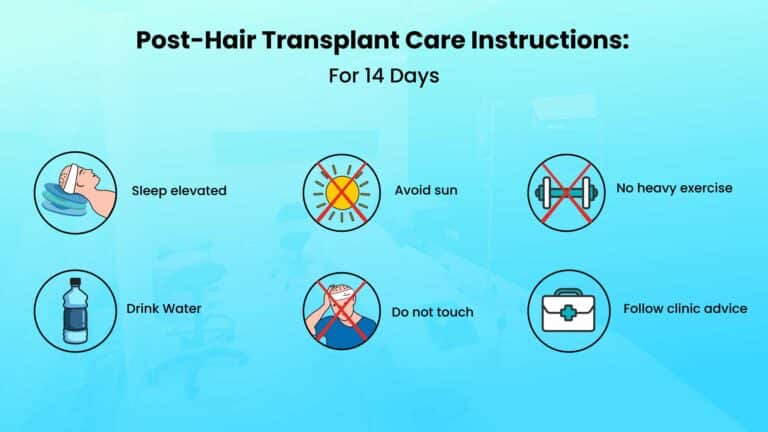
By Prof. Dr. Soner Tatlıdede · August 2026 Post-Op Field Checklist Time Phase Primary Clinical Objective Washing & Care Protocol Recommended Sleep Position Activities & Essentials Days 1 – 3 Protection & graft stabilization No washing allowed (spray moisturizing saline spray only) Sleep on back at a 45° incline with neck pillow Complete rest, avoid bending forward, […]

By Prof. Dr. Soner Tatlıdede · June 2026 TL;DR: Why does my head sweat so much? Excessive head sweating (craniofacial hyperhidrosis) affects 3% of the population and occurs when sweat glands are overactive, triggered by stress, heat, certain foods, or medical conditions. Treatment options include proper scalp care, dietary changes, Botox injections, and prescription medications. […]

By Prof. Dr. Soner Tatlıdede • July 2026 Determining the best age for a hair transplant is one of the most frequent questions raised by individuals experiencing progressive hair thinning or androgenetic alopecia. In the medical world, answering this question goes far beyond a patient’s emotional desire to restore density and youthfulness; it relies on a deep […]


Thank you!
Your details have been successfully submitted. Thanks!