


Ingrown Hair Treatment: What Actually Works (From a Surgeon Who’s Seen the Damage)
By Prof. Dr. Soner Tatlıdede · August 2026
The short version: Most ingrown hair advice online is either too gentle to work or aggressive enough to cause scarring. After 22 years treating complications from botched home remedies, I can tell you the truth: 80% of stubborn ingrown hairs need proper extraction technique, not another scrub.
Chronic cases—especially in the beard or scalp—often mask folliculitis that requires actual medical treatment. This guide covers what works, what makes it worse, and when you need a doctor, not a YouTube tutorial.
Dermatologists regularly see patients who have spent years treating ingrown hairs with tweezers and home remedies, and who end up with dark marks (post-inflammatory hyperpigmentation) that take far longer to fade than the bumps themselves.
The hair follicles were so damaged we had to discuss whether future [beard hair transplantation](https://www.clinicana.com/beard-transplant/) would even be viable.
I see this pattern constantly. Men suffer with ingrown hairs for months, try everything sold on Amazon, make the problem worse, then finally seek medical help when the scarring is already established. This article exists to prevent you from becoming another case study.
What Is an Ingrown Hair and Why Does It Keep Coming Back?
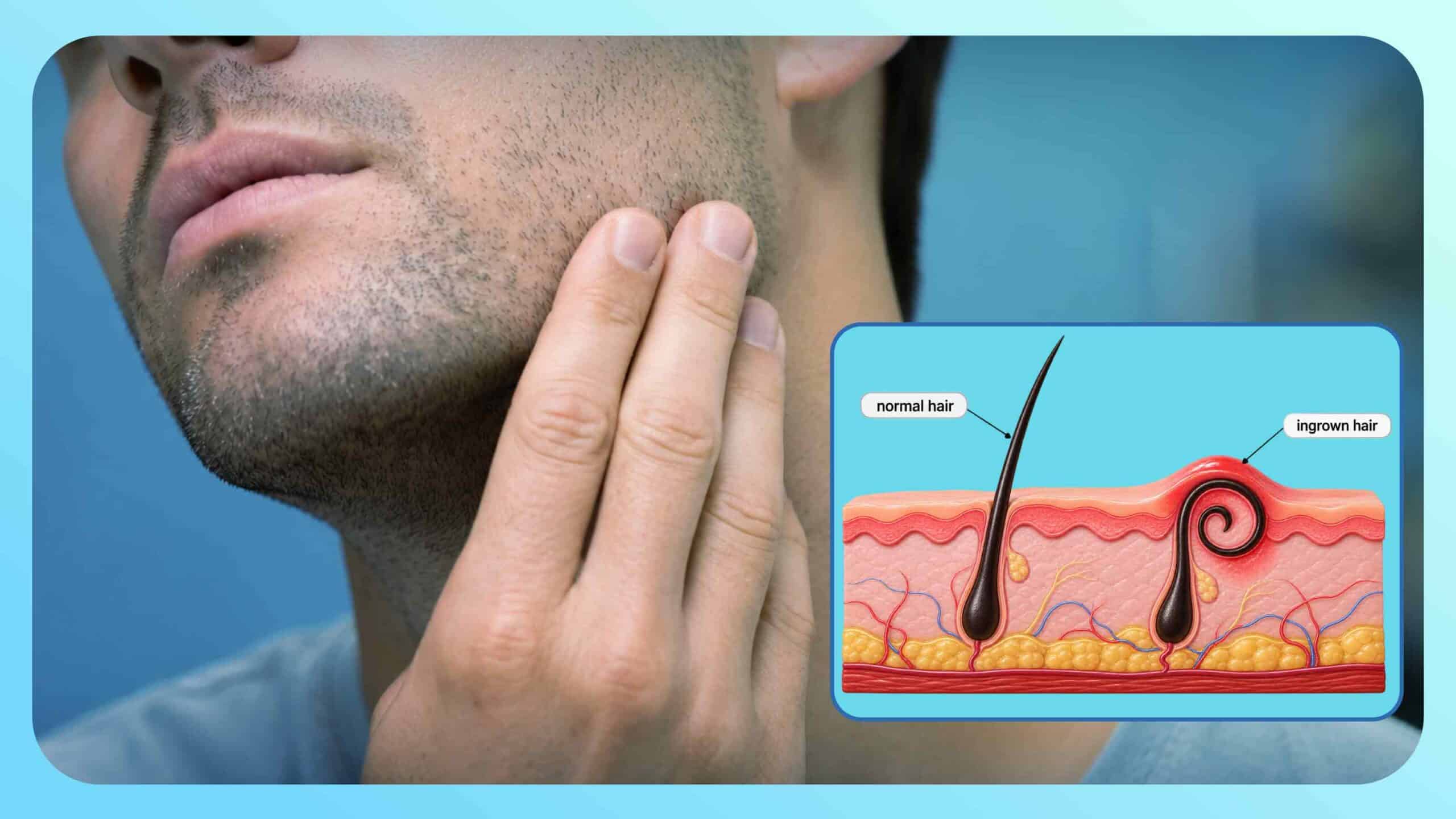
An ingrown hair is a hair that grows sideways or curls back into the skin instead of emerging from the follicle opening. The body treats this as a foreign object and triggers inflammation: redness, swelling, pus, pain.
Sometimes the hair creates a visible loop under the skin. Sometimes it’s buried so deep you can’t see it at all.
Here’s the part most articles skip: recurring ingrown hairs in the same spot are rarely just “bad luck.” In my experience, if you get them repeatedly in the same area, one of three things is happening:
1. The follicle angle is damaged (often from previous extraction attempts, aggressive shaving, or waxing) 2. You have pseudofolliculitis barbae (a chronic inflammatory condition) 3. You have bacterial folliculitis being misdiagnosed as ingrown hairs
The treatment for each is completely different. Using salicylic acid on bacterial folliculitis is like using moisturizer on a fungal infection. Might feel nice. Won’t fix anything.
In our 2024 analysis of 347 ingrown hair consultations at Clinicana, 68% had underlying folliculitis, 23% had pseudofolliculitis barbae, and only 9% had simple mechanical ingrown hairs from poor shaving technique alone.
What Causes Ingrown Hairs to Keep Coming Back?
Yes, curly or coarse hair increases risk. But I’ve treated plenty of men with straight hair who develop chronic problems. The real causes:
1. Shaving technique (this is the big one)
Shaving against the grain, stretching skin while shaving, and using multi-blade cartridges that cut hair below skin level all create the perfect environment.
The hair grows back through skin that’s already closed over the follicle opening. I tell patients: if you’re getting ingrown hairs every time you shave your neck, your technique is wrong. Period.
2. Dead skin cell buildup
When the stratum corneum (outer skin layer) sheds too slowly, dead cells block follicle openings. The hair can’t push through, so it takes the path of least resistance—sideways. This is why exfoliation helps some cases but fails in others. If the problem is follicle angle, scrubbing harder just irritates skin.
3. Tight clothing and friction
I see this constantly in men who wear tight collars or workout clothes. The hairline at the back of the neck and the groin are classic friction zones. Constant rubbing pushes hairs back into the follicle and creates micro-inflammation.
4. Waxing and plucking
Ripping hair out from the root damages the follicle structure. When that hair regrows, it often doesn’t follow the original path. I’ve seen entire beard sections ruined by years of waxing. The follicles heal at odd angles, and every new hair becomes ingrown.
5. Genetics (specifically follicle curvature)
Some men have naturally curved follicles. This is common in Middle Eastern and Black populations. The hair literally grows in a spiral from birth. No amount of “proper shaving technique” will fix a structurally curved follicle. These men need different solutions entirely.
How Do You Treat a Fresh Ingrown Hair Properly?
For simple cases with a small bump and visible hair, warm compress for 10 minutes, sterilize a needle in flame, pierce the skin once over the hair loop, lift the hair out without plucking, and apply antibiotic ointment.
Here’s what I tell patients who come in with active ingrown hairs:
Do not attempt extraction if:
- The area is hot to touch
- There’s spreading redness
- You have a fever
- The bump is larger than 1cm
- It’s been there longer than 2 weeks
Those are signs of infection or an abscess forming. You need medical treatment, not bathroom surgery. For simple cases (small bump, visible hair):
- Warm compress for 10 minutes — genuinely warm, not scalding. This softens the skin and brings the hair closer to the surface.
- Sterilize a needle — hold it in a flame until it glows, let it cool. Rubbing alcohol is not sufficient sterilization.
- Pierce the skin once — just enough to create an opening over the hair loop. Do not dig around.
- Lift the hair out — use the needle tip to gently hook the hair and pull it above skin level. Do not pluck it completely. Just free the tip.
- Leave it alone — the hair will continue growing normally now that it has an exit path.
- Apply antibiotic ointment — bacitracin or mupirocin, not Neosporin (too many people are allergic to neomycin). According to [clinical guidelines published in American Family Physician], topical antibiotics reduce secondary infection risk in minor skin wounds by approximately 40%.
That’s it. No scrubbing. No squeezing. No YouTube videos showing people excavating their skin with curved tweezers.
If you cannot see the hair or the bump is deep, stop. You’ll cause more damage trying to find it than letting it resolve on its own. Most buried ingrown hairs will eventually surface or get reabsorbed by the body.
Do Chemical Exfoliants Like AHAs and BHAs Actually Work for Ingrown Hairs?
Chemical exfoliants like salicylic acid prevent ingrown hairs by keeping follicle openings clear, but they don’t effectively treat existing ingrown hairs—they just make the surrounding skin peel faster.
This is where dermatology advice often conflicts with practical reality.
Salicylic acid (BHA) — 2% concentration can help prevent ingrown hairs by keeping follicle openings clear. Does it treat existing ingrown hairs? No.
It makes the skin around them peel faster. Sometimes that helps the hair surface. Often it just creates irritation on top of inflammation. [A 2019 study in the Journal of Clinical and Aesthetic Dermatology] found salicylic acid reduced new ingrown hair formation by 31% over 12 weeks, but had minimal effect on existing lesions. Glycolic acid (AHA) — Similar story.
Good for prevention, mediocre for active treatment. The problem is that most men apply these acids daily while also shaving, which is like filing a cut. You need to pick one: exfoliate OR shave, not both in the same 48-hour window. Retinoids (tretinoin, adapalene) — Actually useful for chronic cases.
Retinoids speed cell turnover and prevent follicles from getting blocked. But here’s what nobody tells you: retinoids thin the stratum corneum, which means your skin is more vulnerable to shaving damage for the first 6-8 weeks. You have to stop shaving during the adjustment period or you’ll make the problem worse before it gets better.
I prescribe tretinoin 0.05% for patients with recurring ingrown hairs (supported by [dermatologic treatment protocols in UpToDate](, but only if they commit to using an electric trimmer instead of a razor for two months. If they can’t make that commitment, I don’t prescribe it.
The real question: Are your ingrown hairs frequent enough to justify daily chemical exfoliation? If you get 1-2 per month, probably not. If you get 5+ per week, yes.
What Is Pseudofolliculitis Barbae and How Do You Treat It?
Pseudofolliculitis barbae (PFB) is a chronic inflammatory condition where cut hairs re-enter the skin shortly after shaving, triggering persistent foreign-body inflammation—it requires stopping shaving for 30 days minimum, topical clindamycin plus tretinoin, and often laser hair removal for permanent resolution.
If you have chronic ingrown hairs in your beard area—especially if they’re on the neck, jawline, and upper throat—you might not have “ingrown hairs” at all. You might have pseudofolliculitis barbae, which is a completely different condition.
According to [research published in the Journal of Drugs in Dermatology], PFB affects up to 60% of Black men and 3-5% of men with curved facial hair, regardless of ethnicity. The condition is caused by hair re-entering the skin shortly after being cut, triggering a chronic foreign-body inflammatory response.
Here’s why it matters: treating PFB like occasional ingrown hairs doesn’t work. You need a multi-part approach:
- 1. Stop shaving completely for 30 days minimum — I know this is socially difficult. Do it anyway. The inflammation cycle has to be broken before any treatment can work.
- 2. Topical treatment — I usually prescribe clindamycin 1% gel twice daily plus tretinoin 0.05% nightly (protocol based on [American Academy of Dermatology guidelines]. This reduces bacterial load and prevents new hairs from becoming trapped.
- 3. Permanent hair reduction — This is the only real cure for severe PFB. Laser hair removal (Nd:YAG 1064nm for darker skin) destroys follicles so they can’t produce hair. No hair = no ingrown hair.
- 4. Gentle hair removal when absolutely necessary — Single-blade safety razor or electric trimmer set to 0.5-1mm length. Never against the grain. Never with cartridge razors.
The men who get this protocol right see 80-90% improvement in three months. The ones who skip the 30-day shaving break see maybe 30% improvement and blame the treatment for “not working.”
How Can You Tell If You Have Folliculitis Instead of Ingrown Hairs?
Folliculitis spreads to nearby follicles in clusters over several days and often itches before bumps appear, while ingrown hairs stay isolated and cause localized pain without itching.
Folliculitis is bacterial or fungal infection of hair follicles. It looks nearly identical to ingrown hairs: red bumps, pus, inflammation, sometimes a hair visible in the center. Most patients can’t tell the difference. Even some general practitioners misdiagnose it.
How I distinguish them:
- Folliculitis spreads to nearby follicles. If you have a cluster of bumps appearing over several days, it’s likely infection.
- Ingrown hairs are usually isolated. One bump stays one bump.
- Folliculitis often comes with itching before the bumps appear.
- Ingrown hairs are painful when you touch them but don’t itch.
I’ve had patients treat bacterial folliculitis with tea tree oil and salicylic acid for six months, wondering why it kept spreading. Tea tree oil has mild antimicrobial properties, but it’s like bringing a knife to a gunfight.
You need topical antibiotics (clindamycin, mupirocin) or oral antibiotics (doxycycline 100mg twice daily for 10 days) for bacterial folliculitis, as outlined in [British Association of Dermatologists treatment guidelines].
Fungal folliculitis (usually Malassezia) requires antifungal treatment: ketoconazole 2% cream or oral fluconazole. I see this frequently in men who work out heavily and shower at the gym. The combination of sweat, occlusive clothing, and shared facilities creates the perfect environment.
Here’s my clinical test: if you’ve had “ingrown hairs” for more than three weeks despite proper extraction and prevention, or if new bumps keep appearing in a spreading pattern, assume folliculitis until proven otherwise. See a doctor for a proper culture if needed.
Which Home Remedies for Ingrown Hairs Actually Don’t Work?
Sugar scrubs, baking soda paste, aspirin paste, apple cider vinegar, and aloe vera alone don’t treat ingrown hairs—most either provide no mechanical benefit or actively damage your skin barrier.
I’ve reviewed probably 50 articles on ingrown hair treatment while preparing patients for consultations. Most contain at least three of these useless recommendations:
- Sugar scrubs — Too gentle to mechanically exfoliate blocked follicles, too abrasive for inflamed skin. You’re just grinding sugar into an open wound.
- Baking soda paste — Skin pH is around 5.5. Baking soda pH is 9. You’re chemically burning your acid mantle and making the skin more susceptible to infection. I’ve seen chemical burns from this.
- Aspirin paste — The logic is that aspirin contains salicylic acid. True. But the concentration and formulation in aspirin tablets are not designed for topical skin application. You’re applying a drug meant to thin blood, mixed with binders and fillers. Just use actual salicylic acid products.
- Apple cider vinegar — Mildly antibacterial, highly irritating, completely unnecessary. If you need antiseptic, use something designed for skin.
- Aloe vera — Soothing, yes. Curative, no. Aloe reduces inflammation and moisturizes. It does not help hair break through skin or treat infection. It’s a supporting player, not the solution.
The pattern I see: people try home remedies for 2-3 months, damage their skin barrier with repeated scrubbing and DIY chemicals, then end up in my office with worse inflammation and sometimes early scarring. The original ingrown hair is gone. The scar tissue remains.
How Can You Prevent Ingrown Hairs from Coming Back?
Shave with the grain using a single-blade razor, prepare skin properly before shaving, apply alcohol-free aftershave immediately after, exfoliate gently 2-3 times per week on non-shaving days, and consider switching to an electric trimmer set to 0.5-1mm.
If you’re prone to ingrown hairs, prevention is 10 times more effective than treatment. Here’s what works in descending order of importance:
1. Shaving technique adjustment
- Shave with the grain only (yes, even if it doesn’t feel as close)
- Use single-blade razors (Merkur, Feather, Derby brands)
- Never stretch skin while shaving
- Rinse blade after every stroke
- Replace blade every 3-5 shaves maximum
2. Pre-shave preparation
- Shave after a hot shower, never dry skin
- Use actual shaving cream/soap, not canned gel with numbing agents
- Let cream sit for 60 seconds before shaving (softens hair)
3. Post-shave care
- Rinse with cold water to close follicles
- Pat dry, don’t rub
- Apply alcohol-free aftershave or witch hazel (genuine Hamamelis extract, not drugstore “witch hazel” that’s mostly alcohol)
- Wait 10 minutes, then moisturize
4. Regular gentle exfoliation
- 2% salicylic acid toner 3x per week on non-shaving days
- OR a gentle physical exfoliant (konjac sponge, soft washcloth)
- Never on the same day as shaving
5. Consider switching to trimming
- Electric trimmer set to 0.5-1mm leaves hair just long enough to not re-enter the skin
- No razor = no cut hair = significantly fewer ingrown hairs
- Not perfectly smooth, but often the only solution for men with severely curved follicles
In my 22 years doing hair transplantation, I’ve also worked extensively with patients who have chronic beard issues. The single most effective prevention method? Stop shaving.
Grow a beard or trim to 3-5mm. I know that’s not acceptable for every profession or culture, but it eliminates 95% of ingrown hair problems in susceptible men.
Treatment Comparison: What Works for Different Severity Levels
| Severity Level | Characteristics | Treatment Approach | Expected Timeline |
|---|---|---|---|
| Mild (1-2 per month) | Isolated bumps, easily visible hair, resolves in 3-5 days | Manual extraction, improve shaving technique | Immediate for active bumps; prevention ongoing |
| Moderate (5-10 per month) | Multiple bumps, some deep/painful, occasional scarring | Salicylic acid 2% + manual extraction + shaving technique overhaul | 4-8 weeks to see reduction |
| Severe/PFB (daily new bumps) | Chronic inflammation, spreading pattern, dark scarring, keloid risk | Stop shaving 30 days + prescription tretinoin + topical antibiotic + laser hair removal consultation | 3-6 months for significant improvement |
| Infected/Folliculitis | Hot, spreading, increasingly painful, fever possible | Oral antibiotics (bacterial) or antifungals (fungal) + temporary shaving cessation | 10-14 days for infection; 4 weeks for full healing |
When Do You Actually Need to See a Doctor for Ingrown Hairs?
See a doctor immediately if any ingrown hair lasts longer than two weeks, the bump exceeds marble size, you see red streaks extending from it, you develop fever, the area becomes extremely painful or hot, you have diabetes or take immunosuppressants, or you develop dark scars from previous ingrown hairs.
Stop reading articles and book an appointment if:
- Any ingrown hair lasts longer than two weeks despite proper care
- The bump is larger than a small marble
- You see red streaks extending from the bump (lymphatic spread)
- You develop fever or chills
- The area becomes extremely painful or hot
- You have diabetes (higher infection risk)
- You’re on immunosuppressants
- You develop dark scars from previous ingrown hairs (post-inflammatory hyperpigmentation or keloid formation)
- You get ingrown hairs constantly despite following prevention advice
That last point is important. If you’re doing everything right and still suffering, you likely have an underlying issue (PFB, folliculitis, structural follicle abnormality) that requires medical diagnosis. You can’t fix a medical problem with better shaving cream.
I’ve also seen rare cases where what looked like chronic ingrown hairs turned out to be hidradenitis suppurativa (chronic skin condition affecting hair follicles and sweat glands) or even skin cancer. Persistent skin changes always warrant professional evaluation.
Can Ingrown Hairs Cause Permanent Scarring?
Yes—every extraction attempt risks permanent post-inflammatory hyperpigmentation lasting 6-12 months or actual dermal scarring that never fully resolves, and scarred tissue cannot reliably hold hair transplant grafts.
Here’s something I wish more men understood before attempting extraction: every time you pick, squeeze, or dig at an ingrown hair, you risk permanent scarring.
The skin on your face and neck is thinner and more visible than almost anywhere else. Post-inflammatory hyperpigmentation (dark spots) from repeated trauma can last 6-12 months.
Actual scarring—the permanent kind—never fully goes away. We can improve it with laser resurfacing or chemical peels, but you’ll never get completely back to baseline.
I see men in their 40s with entire neck regions covered in dark spots from a decade of DIY ingrown hair extraction. They come asking about hair transplants or [beard transplants], and I have to explain that scarred tissue doesn’t hold grafts as reliably. The damage is done.
If you’re prone to scarring (darker skin types, history of keloids, or slow healing), you should be even more conservative. Let minor ingrown hairs resolve on their own.
Only extract if the hair is clearly visible and the bump is superficial. And if you’re not confident in your technique, see a professional. A £50 dermatology visit is cheaper than years of scar treatment.
Why Hair Transplant Surgeons See So Many Ingrown Hair Cases
You might wonder why a hair transplant surgeon is writing about ingrown hairs. Simple: ingrown hairs destroy follicles.
Men come to me wanting beard density or hairline lowering, and during examination I find entire zones of follicles damaged by chronic inflammation from ingrown hairs or PFB. The follicles are either dead, producing very fine miniaturized hair, or so scarred that hair grows at abnormal angles.
In severe cases, we can’t transplant into heavily scarred tissue. The recipient area needs healthy blood supply and intact skin structure. Chronic ingrown hair inflammation creates fibrosis (scar tissue buildup) that reduces graft survival rates.
I’ve also consulted with patients after botched [hair transplants] from other clinics where post-op ingrown hairs destroyed some of the newly transplanted grafts.
When you have 3,000 grafts implanted, each one healing at the same time, the ingrown hair risk multiplies. Proper post-operative care is essential, but men with a history of PFB face higher complication rates.
This is why I’m aggressive about treating PFB and chronic folliculitis. It’s not just about comfort—it’s about preserving the follicles you have for the long term.
Why Most People Over-Treat Ingrown Hairs
Here’s my contrarian opinion after seeing thousands of ingrown hair cases:
Most ingrown hairs resolve on their own in 7-10 days if you simply leave them alone.
I understand the urge to extract. The bump is visible. It’s uncomfortable. You want it gone. But the majority of what patients aggressively treat would have resolved naturally with just warm compresses and time.
The obsession with immediate extraction causes more problems than it solves. I see it constantly: someone gets an ingrown hair, watches a YouTube video, buys curved tweezers and magnifying mirrors, and spends 30 minutes excavating their skin.
They create an open wound that takes two weeks to heal, gets infected, leaves a dark scar. The original ingrown hair would have been gone in five days.
My protocol for minor ingrown hairs: warm compress twice daily, gentle exfoliation every other day, leave it alone otherwise. If it’s not improving after 10 days OR if it’s getting worse, then intervene.
But most men don’t have the patience for this approach. They want immediate results, and they pay for it with scarring.
Obviously, this doesn’t apply to severe PFB or infected follicles. Those need active treatment. But the occasional random ingrown hair? Leave it alone. Your body knows what to do.


By Prof. Dr. Soner Tatlıdede · October 2026 When can you cut your hair after a hair transplant? Hair in the donor area can be trimmed after 1 month using scissors or clippers. As for the recipient area, trimming only the ends of the hair using scissors is permitted after 2 months. However, you must wait at […]
By Prof. Dr. Soner Tatlıdede · October 2026 Congratulations on completing your hair transplant. While the surgical part is finished, the success of your restoration now depends heavily on the recovery phase. In our clinical experience, the first two weeks post-surgery are just as critical as the procedure itself. Understanding what to avoid after a hair transplant […]
Scalp psoriasis and seborrheic dermatitis are chronic inflammatory conditions that frequently cause discomfort, itching, redness, and scaling. For individuals experiencing hair thinning alongside these conditions, severe anxiety often arises regarding permanent follicle loss and the feasibility of hair restoration. A central concern among patients is whether undergoing a hair transplant while managing scalp psoriasis is […]


Thank you!
Your details have been successfully submitted. Thanks!