


The Real Risks of Cheap Hair Transplants in Turkey: A Safety Guide

Hunting for a cheap hair transplant in Turkey can feel like navigating an endless online sale. You want a deal that saves you thousands, which is understandable.
However, unlike buying a discounted gadget, compromising on medical procedures has permanent consequences.
When it comes to your hairline, the “lowest price” often carries the highest risk. Here is how to distinguish between a smart, affordable choice and a dangerous regret.
Why “Cheap” Isn’t Always a Bargain in Medical Tourism
It’s easy to be tempted by an ad for a hair transplant in Istanbul for $899. It sounds like a steal, but you must ask: how is this price possible?
In the medical world, there is a massive difference between “affordable” and “cheap.” Often, rock-bottom prices are code for cut corners.
The most reputable clinics aren’t necessarily the most expensive, but they never sacrifice safety for a discount. They offer value, balancing cost with medical standards.
How Some Clinics Cut Corners to Lower Prices
Here is the harsh reality: a high-quality hair transplant requires time, sterile environments, and highly skilled medical staff.
If a clinic offers a price that seems too good to be true, they are likely compromising on one of these pillars:
- Overcrowding: Cramming 10-15 patients a day into a facility like a factory line.
- Ghost Doctors: Using inexperienced technicians instead of licensed surgeons for critical steps (like channel opening).
- Hygiene: Cutting costs on sterilization and single-use tools.
Risking your health to save a few hundred dollars is never a wise investment.
The Hidden Costs: What Cheap Packages Often Exclude
Many “all-inclusive” low-cost packages appear attractive initially, but they often achieve those prices by stripping away critical medical necessities.
When you book a budget procedure, you are frequently losing out on:
- PRP Therapy (Platelet-Rich Plasma): Essential for boosting healing and maximizing graft survival rates. Budget clinics often charge extra for this or skip it entirely.
- A Real Surgeon on Site: In many cut-rate clinics, the “surgeon” is merely a supervisor who steps in for a minute. The actual labor is left to unlicensed technicians.
- Medical Aftercare: True recovery support isn’t just a printed pamphlet and a handshake. Cheap clinics rarely offer the necessary 12-month medical follow-up to monitor your growth and prevent complications.
5 Severe Risks Hidden in Ultra-Cheap Hair Transplant Packages
While a low price tag is appealing, the psychological cost can be devastating. Here are the five most common complications patients face when choosing unregulated, low-cost clinics:
- Massive Graft Failure (The “Thin” Result)
The worst nightmare for any patient is enduring the surgery only to have the transplanted hair fail to grow.
In rush-job clinics, grafts are often mishandled or left out of the body too long, causing them to die before they are even implanted.
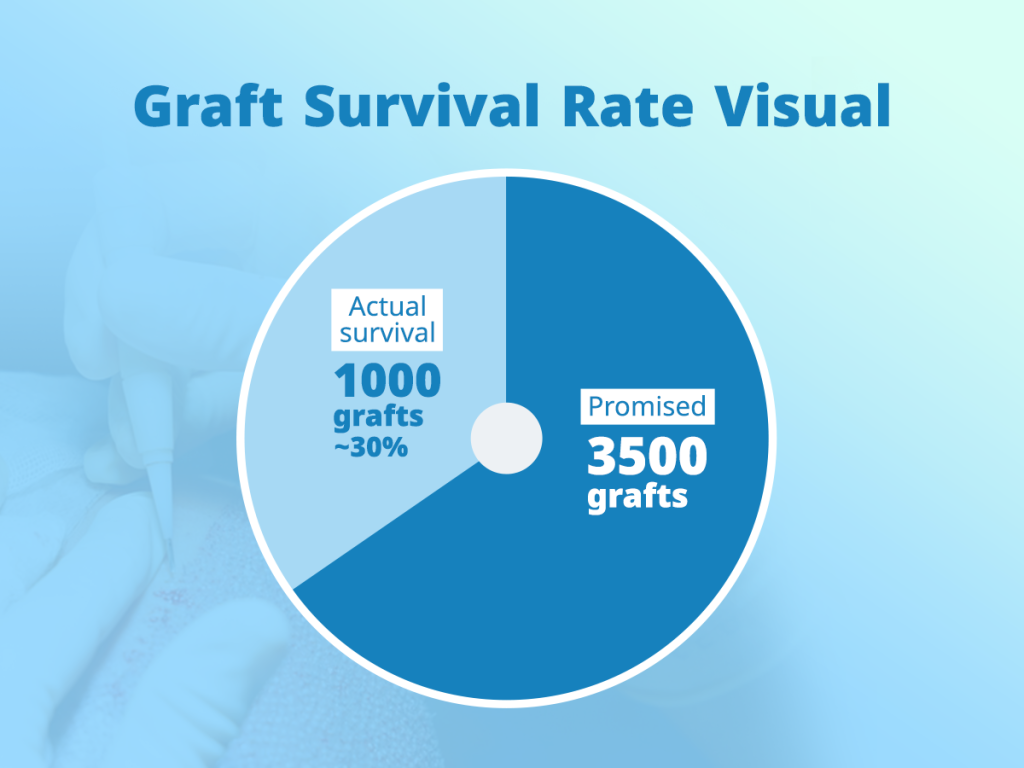
You might pay for 4,000 grafts, but if the survival rate is only 30%, you will be left with sparse, patchy results that require expensive repair.
- Unnatural, “Doll-Like” Hairlines
An artistic eye is just as important as medical skill. Unqualified technicians often draw hairlines that are too straight, too low, or completely mismatched to your facial muscle structure.
This results in the dreaded “pluggy” look that screams “hair transplant gone wrong.” A cheap transplant is immediately noticeable; a good one is invisible.
- Infection, Necrosis, and Poor Hygiene
Hygiene is non-negotiable. Cheap clinics often operate in “apartment” settings rather than sterile hospitals, reusing disposable tools to save money.
This significantly increases the risk of dangerous infections and even necrosis (skin tissue death), which leaves permanent, unfixable scars in the recipient area.
- Zero Aftercare and “Radio Silence“
In the budget market, the service usually ends the moment you pay. Once you fly home, you may face total radio silence.
If you experience swelling, shock loss, or signs of infection, you are left Googling remedies on your own. Many patients who express Turkey hair transplant regret cite this lack of medical support as their biggest mistake.
- 5. Ghost Doctors and Fake Portfolios
It is shockingly common for budget clinics to use stock photos or stolen results from other doctors. Worse, the “surgeon” you meet during the consultation may not even enter the operating room.
Instead, your head is entrusted to a rotating team of freelancers with no accountability for the outcome.
How to Spot a Safe Hair Transplant Clinic (Without Overpaying)
Finding a balance between quality and cost is possible if you know exactly what to look for. Use this checklist to filter out high-risk clinics:
Transparency About the Surgeon
A trustworthy safe hair transplant clinic will proudly display their head surgeon’s full name, biography, and medical license number on their website.
- The Red Flag: If a clinic uses vague terms like “our expert team” or “experienced specialists” without naming a specific doctor, take it as a warning sign.
- The Rule: Always ask, “Who is the supervising doctor, and will they be present during my surgery?”
Honest Before/After Galleries
Don’t be fooled by a single “perfect” photo. Hair growth is a journey. Legitimate clinics provide detailed case studies that show the progression: immediately post-op, at 6 months, and the final result at 12 months.
- What to Look For: High-resolution videos and photos taken under consistent lighting, showing different angles—not just the best side.
Comprehensive Medical Packages (No Hidden Costs)
True affordability means transparency. The best budget-friendly clinics offer “all-inclusive” packages that cover every medical necessity: consultation, blood tests, anesthesia, medications, and PRP therapy.
- The Trap: Avoid clinics that lure you in with a low base price (e.g., €1,000) but then charge extra for essential items like painkillers, washing lotions, or necessary grafts.
Verified Third-Party Reviews
Never rely solely on testimonials published on a clinic’s own website. Dig deeper into independent platforms like Google Reviews, Trustpilot, and RealSelf.
- Pro Tip: Look for detailed reviews that mention specific staff members or doctors by name. Generic five-star reviews like “Great place, thanks” are often fake. Real patients write about their pain levels, the hotel quality, and the communication speed.
Price Expectations in Turkey: What’s “Too Cheap” to Trust?
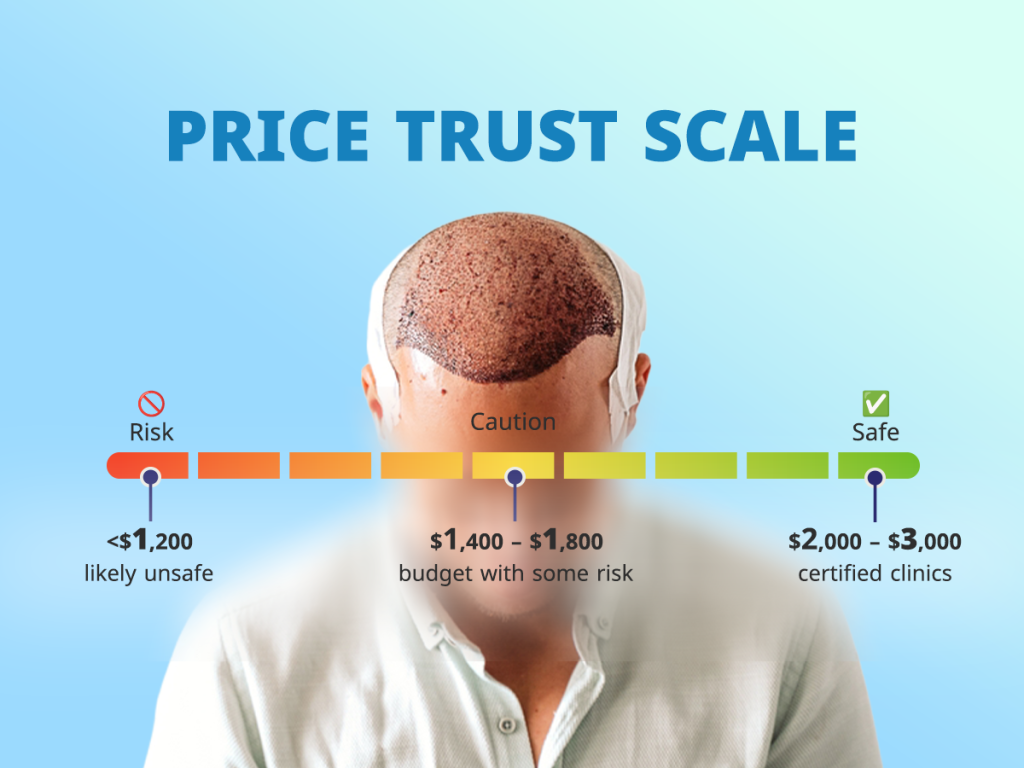
Hair transplant pricing in Turkey varies widely, but extremely low packages often signal missing medical essentials (sterility standards, qualified supervision, or real aftercare).
Medical tourism organizations have also warned that choosing purely based on price can lead to costly consequences later (including corrective procedures).
| Type of clinic | Typical price range (USD) | Red flag? |
|---|---|---|
| Accredited, hospital-based clinic (licensed surgeon-led) | $2,000–$3,000 | ❌ No |
| Budget clinic (ethical, transparent, limited extras) | $1,400–$1,800 | ⚠️ Depends |
| “Under $1,200 total” packages | Under $1,200 | ✅ Yes |
If you see a package under $1,200, pause and investigate what is not included.
At that price point, patients commonly end up trading away one or more non-negotiables: hygiene/sterile setup, surgeon involvement in critical steps, and structured follow-up once they fly home.
Your real “cost” is not just the procedure—it’s the safety margin and the support that protects your result.
Real Stories: Why Patients Regret Choosing Price Over Quality
It is easy to find glowing reviews online, but forums and support groups are filled with cautionary tales from patients who prioritized the lowest bid.
These real-world scenarios highlight exactly why “bargain” surgery is rarely a saving in the long run.
Case A: The “Low Survival” Trap
James, 29: Thought he scored a deal with 3,500 grafts for under $1,000. One year later, only sparse patches had grown—an estimated 30% survival rate.
He is now saving for a corrective transplant, which will be more difficult and costly due to the scar tissue left behind. His case is a classic example of overharvesting combined with poor handling of grafts.
Case B: The Infection Nightmare
Sarah, 34: Had her procedure in an office-block clinic and flew home the next day without clear instructions.
When she developed a painful infection, she reached out to the clinic but received no reply. Sarah ended up in her local ER for antibiotics.
Her advice? “Ask about aftercare before you book—if they don’t have a medical team to answer you later, don’t go.”
Case C: The Unnatural Hairline
Alex, 45: His budget clinic gave him a hairline suited for a teenager—straight, low, and dense. At his age, the result looked immediately artificial.
Instead of gaining confidence, Alex now wears a hat daily to hide the work. This is a common result when technicians, rather than experienced doctors, design the hairline without considering facial symmetry and age-appropriate aesthetics.
3 Critical Questions to Ask Before You Book
Before committing to any clinic, ask these three non-negotiable questions. Their answers will reveal more than any brochure ever could.
- “Who will design and implant my hairline—and will they be present during the entire procedure?”
- A reputable safe hair transplant clinic will confirm that a licensed surgeon handles hairline design and supervises every critical step (channel creation, graft placement).
If the answer is vague (“our team” or “experienced specialists”), it often means technicians do the bulk of the work. - Why it matters: Your hairline defines whether the result looks natural or noticeably artificial. This is not a task for someone with a weekend certificate.
- A reputable safe hair transplant clinic will confirm that a licensed surgeon handles hairline design and supervises every critical step (channel creation, graft placement).
- “What is your clinic’s documented graft survival rate?”
- Clinics with transparent medical standards will provide data—typically 85–95% survival for FUE when performed correctly. If a clinic cannot answer or deflects (“We guarantee results!”), it is a warning sign.
- Why it matters: If you pay for 4,000 grafts but only 50% survive, you are left with the density of a 2,000-graft procedure—and you will likely need costly repair.
- “What follow-up support do you provide after I return home?”
- Ethical clinics offer structured aftercare: WhatsApp/video consultations, monthly check-ins, and access to medical staff for at least 12 months post-op. Some even partner with doctors in your home country.
- Why it matters: Complications (shock loss, cyst formation, delayed growth) often emerge weeks or months later. If the clinic goes silent, you are left Googling solutions or paying another doctor to intervene.
FAQ
Is it safe to have a hair transplant in Turkey?
Yes, it is generally safe, provided you choose an accredited, hospital-based clinic. Turkey is a global hub for hair restoration with world-class surgeons.
However, the risk arises when patients choose unlicensed “black market” clinics operating in apartments to save money.
Safety depends entirely on where you go, not just the country itself.
Are hair transplants in Turkey better or just cheaper?
They are often both, but for different reasons. The lower cost is primarily due to Turkey’s lower cost of living and currency exchange rates, not low quality.
However, the “better” part comes from experience; top Turkish surgeons perform thousands of procedures annually, giving them unmatched expertise.
The key is to distinguish between cheap low-quality clinics and affordable high-quality medical centers.
How much does a 5000 grafts hair transplant cost in Turkey?
For a reputable clinic that follows safety protocols, a mega-session (4,000–5,000 grafts) typically costs between $2,500 and $4,000.
Be very cautious of clinics offering this amount for under $1,500, as harvesting 5,000 grafts requires extreme skill to avoid permanently damaging the donor area (overharvesting).
What percentage of Turkish hair transplants fail?
There is no official national statistic, but industry experts estimate that failure rates in budget, technician-run clinics can be as high as 30-40% (due to poor graft handling or unnatural designs).
In contrast, accredited medical clinics typically maintain graft survival rates of 90-95%.
What usually goes wrong with cheap hair transplants in Turkey?
The most common complications in budget clinics include overharvesting (leaving the back of the head patchy), necrosis (skin death due to poor blood supply), unnatural “pluggy” hairlines, and severe infections caused by unsterile tools.
Most of these issues are preventable by choosing a qualified surgeon over a low-cost technician.
Final Verdict: Safe Doesn’t Mean Expensive, But Smart Means Careful
Not every affordable clinic is a risk. There are legitimate medical facilities in Turkey that offer high-quality results for under €2,500 by being efficient, not reckless.
These clinics manage costs through volume and expertise, not by hiring unqualified staff or reusing tools. It is entirely possible to save money and get a world-class result—you just have to dig deeper than the advertised price tag.
Focus on Value, Not Just Cost
If you take one thing from this guide, let it be this: Don’t choose a clinic just because it’s the cheapest. Choose it because it offers value.
True value means paying for:
- Real medical expertise (a licensed doctor, not just technicians).
- Safety protocols (hospital-grade sterilization).
- Long-term support (someone to answer your questions 6 months later).
Finding a certified hair restoration facility in Istanbul can be life-changing if you do your homework. Ask the hard questions, demand transparency, and trust your instincts
Don’t just chase the lowest number—chase the best permanent outcome for yourself. After all, this isn’t just about hair; it’s about your confidence, your health, and getting it right the first time.



If you are researching your options for hair restoration, one question stands above the rest: How much does a hair transplant cost in Turkey, and is the quality actually safe? In 2026, the global price gap has widened. While clinics in London and New York are raising prices to cover inflation and overhead, Istanbul has […]

“Should I postpone the procedure until winter, or take advantage of my summer vacation?” This is the most frequent question echoing through the halls of Clinicana in Turkey. Behind this simple inquiry lie real anxieties. Patients aren’t just asking about the weather; they are concerned about the safety of their new follicles, the speed of […]

Shock loss after a hair transplant can be startling, but here is the good news: it’s often a natural sign that your scalp is healing. While it might feel counterintuitive to see hair falling after a procedure meant to restore it, this “shedding phase” is typically a temporary bridge to your final, permanent results. At […]


Thank you!
Your details have been successfully submitted. Thanks!