


Galea Aponeurotica (Epicranial Aponeurosis): Anatomy, Function and Hair
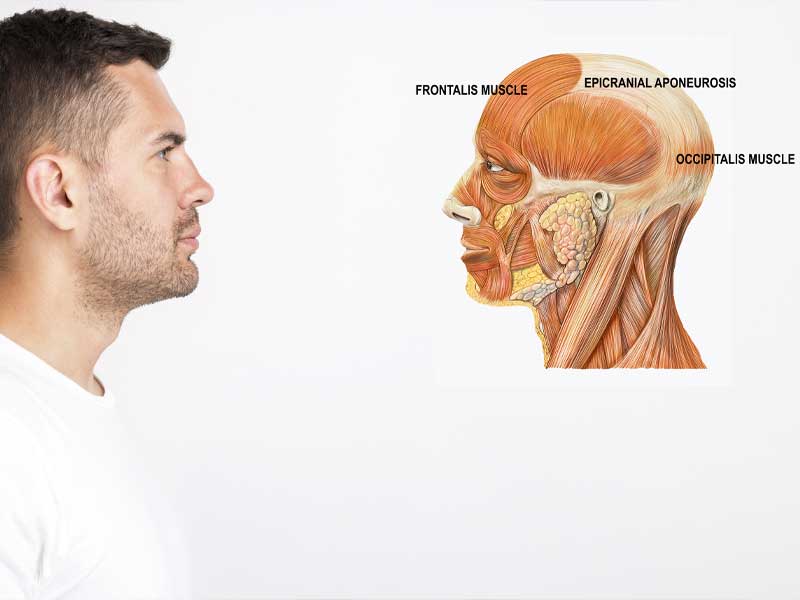
The galea aponeurotica, also called the epicranial aponeurosis, is the tough, flat sheet of fibrous tissue that covers the top of your skull like a cap. It connects the two parts of the occipitofrontalis muscle: the frontalis at the forehead and the occipitalis at the back of the head. It is the third of the five layers of the scalp, and it is the reason the scalp moves as one unit, why deep scalp cuts gape open, and why surgeons pay close attention to it in every hair transplant.
What is the galea aponeurotica?
“Galea” is Latin for helmet, and “aponeurosis” means a flat, tendon-like sheet that a muscle pulls on. The galea aponeurotica is exactly that: a broad tendon without a bone at either end. Instead, it links muscles:
- At the front, it blends into the frontalis muscle, which runs down to the skin of the eyebrows.
- At the back, it joins the occipitalis muscle, which is anchored to the back of the skull along the superior nuchal line.
- At the sides, it thins out over the temples and connects with the temporoparietal fascia and the small temporoparietalis muscle above the ears.
Together, the two muscle bellies and the galea between them are often described as one muscle–tendon unit, the epicranius or occipitofrontalis.
The five layers of the scalp (SCALP)
Anatomists remember the scalp’s layers with the acronym SCALP, from the surface inwards:
| Layer | What it is | Why it matters |
|---|---|---|
| Skin | Thick skin carrying the hair follicles and sweat and oil glands | Where every hair grows |
| Connective tissue | Dense fatty tissue full of blood vessels and nerves | Supplies the follicles; vessels here bleed heavily when cut |
| Aponeurosis | The galea aponeurotica | Strong, fibrous, moves with the muscles |
| Loose areolar tissue | A thin, loose layer that lets the upper three layers glide | The “danger space” where blood or infection can spread |
| Pericranium | The membrane covering the skull bone | Firmly attached to the bone |
The first three layers (skin, connective tissue and galea) are bound tightly together and move as a single sheet, sometimes called the “scalp proper”. The loose layer underneath is what allows that sheet to slide over the skull.
What does the epicranial aponeurosis do?
- Transmits muscle pull. When the frontalis contracts, it lifts the eyebrows and wrinkles the forehead; the occipitalis pulls the scalp backwards. The galea is the link that lets the two work together.
- Holds the scalp together. Its strength keeps the outer scalp layers from stretching and tearing.
- Protects. It forms a tough layer over the skull beneath the softer skin and fat.
Why the galea matters in medicine
Scalp wounds that gape and bleed
A shallow cut that stops above the galea stays fairly closed. A cut through the galea gapes open, because the frontalis and occipitalis pull the edges apart. The vessels in the connective-tissue layer above it are held open by the dense tissue around them, so scalp wounds bleed heavily. Doctors repair a cut galea as its own layer when they close a deep scalp wound.
Subgaleal haematoma
Blood can collect in the loose layer between the galea and the pericranium. In newborns this is a recognised risk after vacuum-assisted delivery, and because the space is large and continuous, the bleeding can be significant.
The “danger space”
The loose areolar layer beneath the galea contains small veins that connect with veins inside the skull. That is why infections in this layer have traditionally been treated as potentially serious.
Galeotomy in reconstructive surgery
Because the galea barely stretches, surgeons who need to close a large scalp defect sometimes make careful parallel cuts in it (galeal scoring or galeotomy). This lets the scalp stretch a little further. It is a reconstructive technique, not a treatment for hair loss.
The galea and hair transplants
Hair follicles sit in the skin and the fatty connective tissue above the galea, so a hair transplant works entirely in those upper layers:
- In FUE, each follicular unit is extracted with a small punch from the donor area. The depth is controlled so the graft comes out whole without going deeper than necessary.
- In the recipient area, the small channels or DHI implanter placements are made at the depth of the follicles, well above the galea.
- Scalp laxity, meaning how easily the scalp moves over the skull, depends partly on how the galea and the loose layer beneath it behave. A tight scalp makes extraction harder and mattered even more in the older strip (FUT) technique, where the donor wound had to be closed.
For how the different techniques work in practice, see our guide to hair transplant techniques.
Does galea tension cause hair loss?
You will find claims online that a “tight galea” squeezes blood flow and causes male pattern baldness. It is an interesting hypothesis: pattern hair loss does tend to affect the area covered by the galea, while the sides and back, where muscle lies beneath, are usually spared. But it has not been proven. The established cause of male pattern hair loss is genetic sensitivity of the follicles to the hormone DHT, which gradually shrinks them (see hair miniaturization). Treatments aimed at relaxing the galea, including cutting it, are not recommended treatments for hair loss.
What is well established is that the back and sides of the scalp keep their hair because those follicles are resistant to DHT. That is exactly why a hair transplant moves follicles from the donor area to the thinning top of the head, and why the results last.
Frequently asked questions
Is the galea aponeurotica a muscle?
No. It is a flat sheet of tendon-like tissue that connects two muscles: the frontalis at the front and the occipitalis at the back.
What is the difference between the galea and the epicranial aponeurosis?
There is none. They are two names for the same structure, and “galea” is often used on its own as shorthand.
Can you feel the galea?
Not directly. But when you raise your eyebrows and feel your scalp shift, you are feeling the frontalis pull on the galea and move the whole scalp.
Is the galea involved in a hair transplant?
Only indirectly. Follicles are taken from and placed into the layers above it, and the galea is not cut. Scalp laxity, which the galea influences, can affect how easy extraction is.


By Prof. Dr. Soner Tatlıdede · October 2026 When can you cut your hair after a hair transplant? Hair in the donor area can be trimmed after 1 month using scissors or clippers. As for the recipient area, trimming only the ends of the hair using scissors is permitted after 2 months. However, you must wait at […]
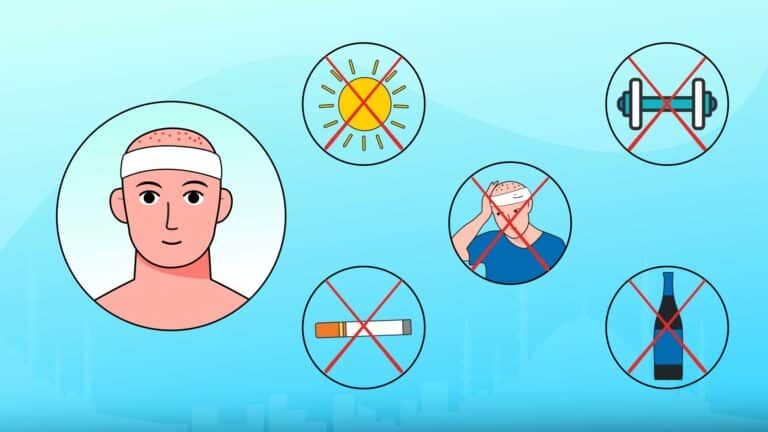
By Prof. Dr. Soner Tatlıdede · October 2026 Congratulations on completing your hair transplant. While the surgical part is finished, the success of your restoration now depends heavily on the recovery phase. In our clinical experience, the first two weeks post-surgery are just as critical as the procedure itself. Understanding what to avoid after a hair transplant […]
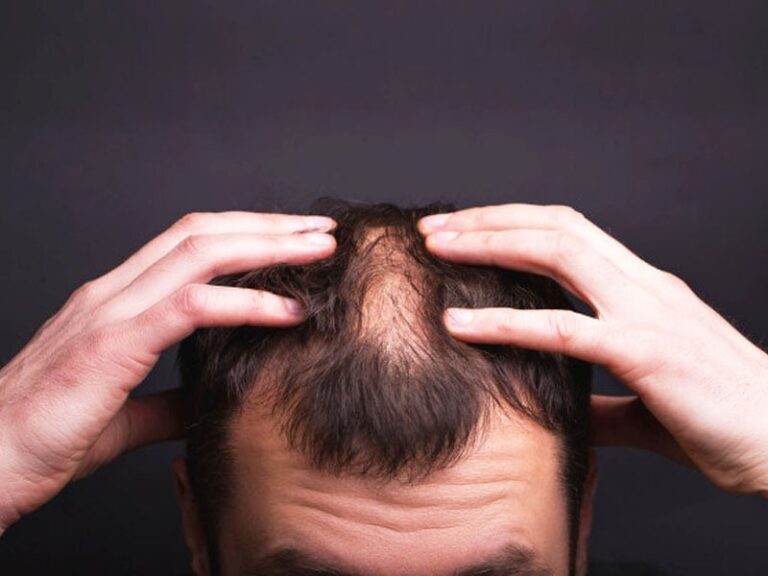
Scalp psoriasis and seborrheic dermatitis are chronic inflammatory conditions that frequently cause discomfort, itching, redness, and scaling. For individuals experiencing hair thinning alongside these conditions, severe anxiety often arises regarding permanent follicle loss and the feasibility of hair restoration. A central concern among patients is whether undergoing a hair transplant while managing scalp psoriasis is […]


Thank you!
Your details have been successfully submitted. Thanks!