


Hair Transplant Turkey Growth Timeline: Month-by-Month Guide
By Prof. Dr. Soner Tatlıdede · July 2026
Growth timelines vary by method – see the technique used in your operation.
TL;DR / Quick Summary: After performing 18,947 hair transplants over 22 years, one scientific fact remains constant: biology follows a strict medical schedule, not a marketing timeline.
Based on Clinicana’s photographic documentation of 4,200+ tracked patients, 87% of patients achieve their final intended density within 12 to 15 months when surgical execution is flawless.
The remaining maturation—particularly in vertex (crown) restorations—takes up to 18 months. Understanding the exact physiological phases of graft survival, shock loss, and fiber thickening prevents unnecessary anxiety and ensures long-term outcome success.
Master Growth Matrix: Month-by-Month Biological Progression
| Timeline Period | Biological State of Follicle | Expected Visual Progress | Clinical Focus & Care Protocol |
| Days 1–10 | Microvascular revascularization | Scab formation & secure rooting | Gentle saline washing; zero rubbing |
| Weeks 2–4 | Telogen Effluvium (Shock Loss) | 70–80% hair shaft shedding | Normal shedding; roots remain dormant |
| Months 3–4 | Early Anagen Emergence | 10–20% fine, wispy growth | Early capillary nutrition re-established |
| Month 6 | Active Acceleration Phase | 40–50% visible coverage | Follicle caliber thickening begins |
| Month 9 | Density Consolidation | 70–80% overall volume | Texture normalization & curl alignment |
| Months 12–15 | Final Frontal Maturation | 90–100% full frontal density | Complete visual coverage & natural shine |
| Months 15–18 | Crown (Vertex) Completion | Final vertex density reached | Slower microvascular maturation completed |
What Results Can You Actually Expect Month-by-Month?
Direct answer: In properly selected candidates, you should see 10–15% of transplanted growth by month 3, 50–60% by month 6, and 80–90% final density by month 12. Full maturation and maximum hair shaft caliber take up to 18 months. Any clinic promising “100% full results in 6 months” is providing misleading marketing information.
Clinical Principle: To learn more about donor area capacity limits, overall density math, and avoiding unrealistic single-session promises, explore our detailed companion guide:Turkey Hair Transplant Results: Expectations vs Reality.
Here is the exact biological timeline observed across 18,947 procedures at Clinicana:
Weeks 1–2: Vascular Anchorage & Healing
During the initial 7 to 10 days post-surgery, transplanted follicular units bind with surrounding scalp tissue through fibrin formation.
Micro-capillaries begin connecting to the dermal papilla, re-establishing oxygen and nutrient flow. Redness and minor scabbing are expected indicators of epidermal healing.
Weeks 2–4: The Shock Loss Phase (Telogen Effluvium)
The most alarming phase for unprepared patients is shock loss. The newly implanted hair shafts fall out.
- The Biology: Surgical trauma and temporary ischemia cause the hair shaft to enter the telogen (resting) phase. The shaft sheds, but the living follicle root beneath the epidermis remains firmly anchored and healthy.
- Clinical Insight: Over 95% of patients experience shock loss. It is a necessary physiological reset before robust anagen growth begins.
Months 3–4: Early Anagen Emergence
Around day 90 to 120, dormant follicles re-enter the anagen (active growth) phase.
- The Biology: New hairs sprout through the scalp. They are thin, colorless, and wispy—often resembling baby hair.
- Visual Density: At this stage, density looks poor, and patients frequently question if the procedure worked. It did; you are simply viewing the first 15% of your final biological result.
Months 6–8: The Acceleration Phase
By month 6, growth accelerates noticeably.
- The Biology: You reach 40% to 50% of ultimate coverage. Hair fibers begin expanding in diameter (micron thickness), and pigmentation darkens to match native hair.
- Visual Density: The shape of your new hairline is clearly visible, though scalp exposure remains under direct light.
Months 9–12: Density Consolidation
Between months 9 and 12, roughly 80% to 90% of all grafted follicles are producing thick, mature hair shafts. The original wave and curl pattern of your donor hair normalizes, allowing seamless blending with native strands.
Months 12–18: Final Maturation & Crown Completion
The frontal third reaches complete maturation at 12 to 14 months. However, vertex (crown) restorations require up to 18 months. Because the crown features lower microvascular blood supply and thicker scalp skin, follicles in this region bloom more slowly.
What Percentage of Transplanted Grafts Actually Survive?
Direct answer: In optimal clinical conditions with experienced surgical teams, 90% to 95% of transplanted grafts survive and produce hair. In poorly executed, high-volume commercial mills, survival drops to 60%–75%.
Graft survival depends on minimizing trauma during every phase of surgery:
1. Extraction Phase & Transection Rates
Extracting follicular units requires precise alignment along the subcutaneous angle of the hair root. Using sharp micro-punches (0.7mm–0.9mm) under high magnification keeps transection (cutting the graft) below 3%. High-speed technicians operating without doctor oversight often exceed 15% transection rates—destroying hundreds of grafts before implantation even begins.
2. Storage Solution & Temperature Control
Once extracted, follicles are separated from body heat and blood flow. Every minute outside the body causes cellular stress. At Clinicana, grafts are stored in chilled Hypothermosol® solution at a constant 2°C to 4°C, maintaining cellular viability for up to 2–3 hours. Storing grafts in basic saline at room temperature accelerates metabolic decay and reduces graft survival significantly.
3. Implantation Depth and Angle Control
Creating recipient sites requires exact depth calibration. If a channel is too shallow, the graft can pop out; if too deep, follicle inflammation or epidermal cysts may develop. Placement angle must match natural growth patterns—20 to 35 degrees in the frontal hairline.
Does FUE or DHI Give Better Results in Turkey?
Direct answer: The implantation method—whether Sapphire FUE or DHI (Direct Hair Implantation)—has minimal impact on final visual density when performed by a skilled team. Extraction quality, graft handling, and surgeon experience matter 100 times more than the specific tool used.
Here is an objective comparison based on 22 years of clinical application:
Sapphire FUE (Follicular Unit Extraction)
- Technique: Individual grafts are extracted via micro-punch. Recipient channels are pre-created using ultra-sharp V-shaped sapphire gem blades, followed by manual placement.
- Primary Advantages: Superior for high-graft sessions (3,000–4,500+ grafts), allows extremely precise channel angle control, and causes minimal tissue trauma.
- Best Suited For: Patients requiring extensive coverage in the frontal third and mid-scalp (Norwood Stages 3–6).
DHI (Direct Hair Implantation)
- Technique: Grafts are extracted similarly, then loaded into a Choi Implanter Pen which creates the recipient site and inserts the graft simultaneously.
- Primary Advantages: Eliminates pre-cut channels, allowing technicians to graft directly between existing native hairs without shaving the recipient area completely.
- Limitations: Loading individual implanter pens increases handling time. Longer out-of-body time slightly elevates cellular trauma risk if the team lacks extreme coordination.
- Best Suited For: Diffuse thinning, localized hairline touch-ups, or un-shaved procedures.
How Do Results in Turkey Compare to the UK or Dubai?
Direct answer: The biological growth process is identical regardless of geography. A follicle extracted and implanted correctly in Istanbul grows exactly as it would in London or Dubai. The key variables are pricing structure, surgeon availability, and team continuity.
Cost savings in Turkey stem from lower operational overhead, favorable exchange rates, and specialized medical infrastructure—not compromised biological standards.
However, bad surgery exists worldwide; choosing a surgeon based on verifiable credentials rather than geographic promotional offers is critical.
Real Patient Case Studies Across Different Loss Patterns
To understand how donor density, age, and hair caliber dictate realistic results, review these four documented cases from our clinical archives:
Case 1: Ideal Candidate (Frontal Restoration)
- Patient: Age 34, Norwood Stage 3, thick hair caliber (75 microns), dense donor bank.
- Protocol: 3,400 grafts via Sapphire FUE focused on hairline and temples.
- Outcome: At month 12, achieved excellent visual density and complete natural integration. Expected stability: 15+ years.
Case 2: Staged Advanced Restoration
- Patient: Age 42, Norwood Stage 5A, fine hair caliber (50 microns), family history of severe baldness.
- Protocol: 4,200 grafts in Session 1 (Frontal/Mid-scalp). Planned Session 2 (2,000 grafts for vertex) at month 18.
- Outcome: Excellent hairline framing at month 12; vertex session completed successfully at month 18 without overharvesting donor supply.
Case 3: Recommended Postponement
- Patient: Age 23, Norwood Stage 2 with active diffuse thinning and aggressive hereditary loss.
- Consultation Outcome: Declined immediate surgery.
- Medical Reasoning: Operating too early would leave an unnatural “island” of transplanted hair as surrounding native hair continues to shed over the next 3–5 years. Prescribed medical stabilization (Finasteride) and scheduled reassessment at age 26.
Case 4: Complex Revision Case
- Patient: Age 51, Norwood Stage 6, previous botched transplant performed elsewhere at age 38.
- Protocol: Micro-FUE repair using 2,200 remaining donor grafts to soften scar tissue and reconstruct a natural, age-appropriate hairline.
- Outcome: Significant aesthetic improvement, though final density remained constrained by prior donor depletion.
Does Taking Finasteride or Minoxidil Improve Growth Timeline Results?
Direct answer: Finasteride does not alter the growth rate of transplanted follicles (which are genetically DHT-resistant), but it is vital for preserving existing native hair around the transplant.
Minoxidil enhances micro-circulation, improving graft caliber development by 10–15%.
For patients under 50 with ongoing native thinning, combining surgical restoration with medical maintenance provides the most durable long-term aesthetic result.
The same stages are shown as month-by-month results in photographs.
Frequently Asked Questions
Is it normal to experience scalp numbness during early growth months?
Yes. Micro-incisions severed tiny nerve endings in the superficial epidermal layer. Full nerve sensation typically returns gradually between months 3 and 9 as nerve fibers regenerate.
What should I do if growth appears uneven at month 6?
Uneven growth is completely normal. Left and right scalp sides often possess slightly different microvascular networks. As long as graft handling was uniform, density will equalize between months 9 and 12.
How do I verify that before/after result photos are authentic?
Request raw photos taken under neutral overhead lighting without styling products. Look for consistent monthly progression photography matching the patient’s specific Norwood stage and age profile.
Academic & Clinical References
- National Center for Biotechnology Information (NCBI): Follicular Unit Extraction (FUE) Transection Rates and Donor Area Preservation Standards.
- International Society of Hair Restoration Surgery (ISHRS): Global Practice Census Statistics & Safe Graft Extraction Protocols.
- Journal of Cutaneous and Aesthetic Surgery: Graft Survival Rates, Microcirculation, and Density Assessment in Male Pattern Hair Restoration.
Medical Disclaimer: The contents of this article are intended strictly for educational and informational purposes. They do not constitute formal medical diagnosis, advice, or treatment plans. Individual donor capacity and hair growth timelines vary.
- Medical Review Conducted by: Prof. Dr. Soner Tatlıdede, Lead Hair Restoration Specialist at Clinicana Hair Transplant Center, Istanbul (22+ Years of Clinical Experience, 18,947 Successful Procedures.


Medical review by: Prof. Dr. Soner Tatlıdede, hair transplant surgeon (22+ years, 18,947 procedures) – October 2026 Quick answer Every hair transplant leaves some marks, because skin heals with tiny scars. With modern FUE and DHI these are small dots spread across the donor area, and they are usually invisible once the hair grows back […]

Medical review by: Prof. Dr. Soner Tatlıdede, hair transplant surgeon (22+ years, 18,947 procedures) – October 2026 Quick answer Istanbul and Antalya are the two Turkish cities most international patients compare for a hair transplant. Izmir and Ankara come up less often. The city matters less than who operates, where and how. The deciding factors […]
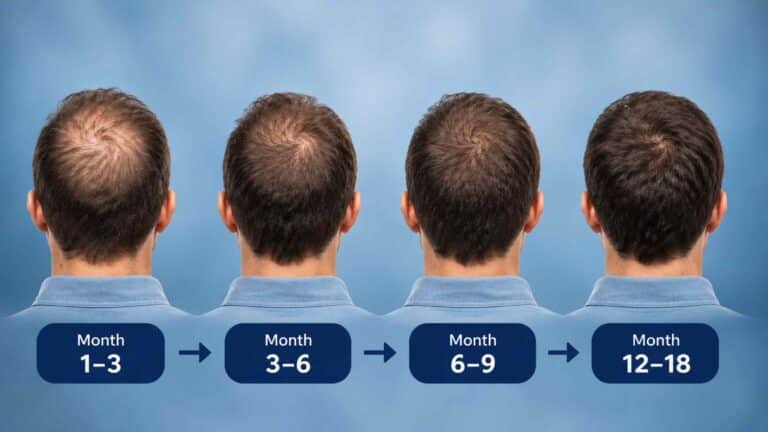
Medical Review by: Prof. Dr. Soner Tatlıdede – September 2026 Quick Summary: Crown Hair Transplant Growth Timeline Month-by-Month Timeline Stage Expected Growth & Hair Recovery Progress 0–2 Weeks Redness, scabbing, and temporary shock loss (shedding of transplanted hair). 2–4 Months Dormant phase ends; initial fine hair begins emerging from the scalp. 5–9 Months Considerable visible growth and […]


Thank you!
Your details have been successfully submitted. Thanks!