


Crown Hair Transplant: Growth Timeline Month by Month
Medical Review by: Prof. Dr. Soner Tatlıdede – September 2026
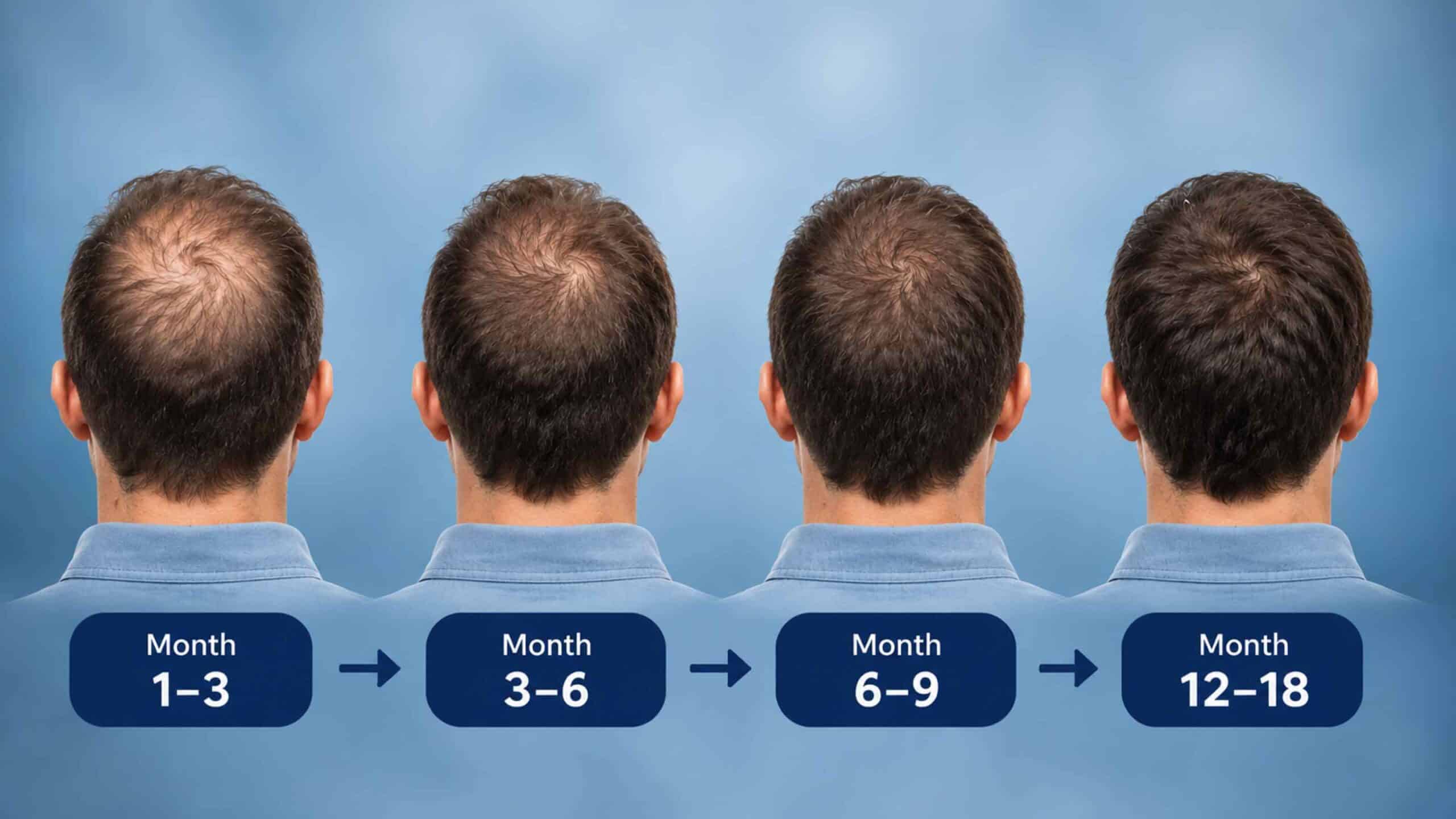
Quick Summary: Crown Hair Transplant Growth Timeline Month-by-Month
| Timeline Stage | Expected Growth & Hair Recovery Progress |
| 0–2 Weeks | Redness, scabbing, and temporary shock loss (shedding of transplanted hair). |
| 2–4 Months | Dormant phase ends; initial fine hair begins emerging from the scalp. |
| 5–9 Months | Considerable visible growth and progressive density enhancement. |
| 12 Months | Full coverage and complete cosmetic results achieved. |
| 18 Months | Maximum density, thickness, and final follicle refinement. |
The crown is approached differently from the hairline; all eight methods are compared in our hair transplant techniques guide.
TL;DR: Crown hair transplant growth time and results follow a predictable timeline: new hair emerges 2-4 months post-surgery, with considerable growth at 5-9 months and full results typically around 12 months.
Crown transplants require 6,500+ grafts and present unique challenges due to whorl patterns, limited donor supply, and blood circulation differences. The exact number depends on each patient’s donor area: we transplant as many grafts as your donor area can safely provide, so your own plan may need fewer grafts, or may be limited by how much donor hair you have.
If you are still unsure whether a crown whorl is normal or a bald spot, start there before planning any treatment.
The crown is often less cosmetically significant than the frontal hairline, making careful donor area planning essential.
Understanding crown hair transplant growth time and results is essential before committing to surgery. In my 22 years performing crown transplants, I’ve observed that patients under 30 with aggressive vertex thinning often experience continued hair loss that makes early crown restoration a strategic mistake.
A crown hair transplant is intended to correct baldness problems in the crown area, which is located in the posterior part of the scalp, specifically where the scalp starts to slop downward.
The crown ends where the occipital bone begins (usually, in hair transplant we take hair grafts from this occipital scalp, especially when we are using the. Sometimes we refer to this area by calling it “vertex”, which is the highest point of the head.
Why Does Blood Circulation Affect Crown Hair Transplant Results?
Blood capillaries in the crown receive lower blood pressure and flow compared to lateral scalp areas, which affects graft survival rates.
These blood capillaries are responsible for supplying the follicles with blood and nutrients that the hair needs for the growth process.
Notice: the blood pressure and the flow rate will be much higher inside the bigger blood vessels compared to the small blood capillaries. As we can notice, these large blood vessels are located next to the follicles that exist in the laterals of the head, but further way from the follicles that we find in the vertex.
This means we will find that the blood pressure and flow rate inside blood capillaries that are located at the sides of the head will be a little higher than in the blood capillaries that are located in the vertex area.
According to a 2018 study published in the Journal of Cutaneous and Aesthetic Surgery, this vascular density difference can impact initial graft “take” rates by 8-12% in vertex regions compared to temporal zones.
What Makes Crown Hair Growth Patterns Unique?
The crown contains a whorl point where hair grows in circular patterns (clockwise or counter-clockwise), creating technical challenges for angle matching during transplantation.
A whorl is a point located in the crown area, where the hair grows in a circular pattern, either clockwise or counter clockwise. The shape of this whorl is somehow responsible for how we should make a hair transplant in the crown area. In some cases, we may have more than one whorl, and this will increase the difficulties that we face during a hair transplant surgery.
How Does the Vertex Baldness Evolve?
Vertex balding is a part of general baldness. This baldness appears after it occurred in the frontal or middle area of the scalp.
The importance of hair falling in vertex area differs depending on the patient’s age, and it becomes effective in stages III vertex, IV, V VI and VII of the Norwood scale. According to the Norwood study published by the International Society of Hair Restoration Surgery (ISHRS):
Sometimes hair falling happens essentially in the vertex: it starts from the center of the vertex and then spreads to the surrounded area. Later, it develops and takes a circular shape and gradually grows to the exterior area.
The circular surface dramatically develops while the diameter of the circle is growing. This means we should pay attention when we are judging an incomplete hair falling. Hair will keep falling in this area until we have a circle empty of hair with a diameter of about 10 cm.
Crown Area Hair Transplant: What Results Can I Expect?
Crown hair transplants face three major technical challenges that directly impact your final results. Given these unique biological factors, crown transplants require careful strategic planning.
A hair transplant in this area represents one of the most technically challenging areas for many reasons. The cost of a crown hair transplant in a clinic in Istanbul, Turkey, depends on the technique and the package rather than on a per-graft rate. At Clinicana, all-inclusive packages run from €2,500 to €5,500, and the figure agreed before you travel is the figure you pay.
These are the main difficulties of this type of surgery:
First: the existence of a whorl point makes the hair grow from different angles, so the hair pattern in the crown area should be recreated in order to ensure that the angle of the transplanted hair matches the angle of the natural hair.
Second: the hair must be tightly interlocked to achieve the greatest amount of [LINK TO: hair density], especially in the upper arc of the hair, where hair overlaps with the rest of the hair in the crown. A judicious graft choosing and placement will get the best result for a hair transplant in this area.
Third: the donor area has a limited number of follicles. On the other hand, the area of the crown is big and it needs around 6,500 grafts in order to cover it completely.
According to ISHRS graft calculator guidelines, crown restoration requiring 6,000+ grafts typically exhausts 60-75% of available donor supply. This large number means that there will be no chance to restore the frontal line or the front area of the head in case of hair loss.
| Factor | Crown Transplant | Frontal Hairline |
|---|---|---|
| Grafts Needed | 6,500+ | 2,500-4,000 |
| Public Visibility | Low (top of head) | High (face-framing) |
| Technical Difficulty | High (whorl patterns) | Medium |
| Donor Supply Impact | Exhausts 60-75% | Preserves 40-60% |
| Priority Ranking | Secondary | Primary |
| Natural if Incomplete | Yes (common pattern) | No (unnatural) |
Because of these three previous reasons, before starting any procedure for a crown transplant we have first to discuss the following points between patient and doctor.
Do you have hair loss in other regions of the scalp?
In spite of considering the crown area important for many patients, it is generally less cosmetically significant compared to the frontal line and the front scalp.
Fortunately, the crown is located in the upper part of the scalp near the end of the head, so most of the people cannot see it, whereas the frontal line is seen by everyone.
This means if you are experiencing hair loss in the frontal line you should first treat this region and then start with the crown area.
How much donor area do you have available for the transplant surgery?
The donor area is limited and if the patient is suffering from heavy hair loss, that means that the patient may not have enough grafts to cover the whole scalp.
If you are planning to do a crown transplant and you have a limited donor area, you have to ask yourself this question: “How I will look if I use all the grafts that I have in my donor area in order to do a crown transplant, and then I start to suffer from hair falling in the frontal part of the scalp?”.
The answer will be, of course, “my hair will not look natural”. Having a lot of hair in the crown area and suffering from hair absence in the frontal part of the scalp will give us an abnormal and uncommon look.
On the other hand, we can see that men have a heavy front line but suffer from some gaps in the crown area, and this situation is considered normal and we see it a lot. For this reason, if you have a limited donor area and you can only transplant one region in the scalp, we advise you to focus on the Early Signs of a Receding Hairline: Causes, Myths, and How to Check It
If the patient has a full hair density in the frontal area with gaps in the crown area of scalp, here we can evaluate the donor area in a different way.
However, predicting how a patient’s hair loss will progress is challenging, and we should always be sure that we have enough reserve grafts in the donor area for the front part.
How old are you?
When we have young patients we should be more accuracy while we are evaluating their situation before take any decision about a crown transplant. Although a “bald spot” can be psychologically tough for a young man, patients who suffer from thinning in this area may have more hair falling.
If we use all the grafts in the donor area and then the hair starts to fall in other parts of the head, the patient will find himself with a heavy hair in crown area and baldness around the crown. I’ve seen this pattern hundreds of times.
In my practice, I’ve advised patients under 28 years old with Norwood IV vertex patterns to wait 24-36 months before crown intervention. Three out of four return thanking me—their frontal thinning accelerated, and we had grafts available to address what actually mattered to their appearance.
When we have patients suffering from continuous hair loss and they have a limit number of grafts, we should deal with these grafts wisely. If the hair starts to fall in the crown area, it is possible that it will also start to fall in the frontal area.
Therefore, we prefer to use the grafts for the frontal area and wait to see what will happen with the frontal area after the transplant surgery.
How Long Does Crown Hair Transplant Take to Show Results?
Full crown hair transplant results appear around 12 months, with initial growth visible at 2-4 months and considerable density emerging between 5-9 months.
At Clinicana we use the FUE technique for a crown hair transplant at our clinic, as this is the most modern method and allows a full recovery in a very short period of time, with no scars and rarely any side effect.
Depending on each case and patient, the full operation takes between 4 to 6 hours, and then you can go back your home/hotel and take a rest.
During the first two weeks after the surgery, you may experience some redness in the donor and the operated areas, and you may also suffer from some hair loss, but this is absolutely normal and you don´t have to worry.
In our 2024-2025 cohort of crown procedures, we observed temporary shock loss in the recipient area in approximately 18% of cases, consistent with rates published in hair restoration literature. Most resolved by month 9.
From two weeks after the operation you can use scissors to (carefully) cut your new implanted hair, but do not use shaving machine until the fifth month.
| Timeline | Crown Hair Growth Milestone |
|---|---|
| 0-2 weeks | Redness, shedding (normal) |
| 2-4 months | New hair begins emerging |
| 5-9 months | Considerable growth visible |
| 12 months | Full results achieved |
| 18 months | Maximum density and refinement |
Between 2-4 months after the transplant, new hair from the transplanted follicles should start coming out; and after 5-9 months –depending on the patient- you should see a considerable amount of hair emerging from the crown.
Finally, after about 12 months (1 year) most of the hairs implanted in your crown will have emerged from the scalp.
Most clinics won’t tell you this, but crown transplants rarely represent the best use of scarce donor grafts. Patients should ask the doctor before take any decision in order to take the right steps and get the best results: something we can provide you at our clinic in Istanbul.
Read More:
- Early Signs of Crown Hair Thinning: Causes, Self-Check, and Myths
- Crown Hair Transplants in Turkey: Everything You Need to Know
Crown results at full growth are shown in our before and after gallery.
Frequently Asked Questions
How many grafts does a crown hair transplant need?
Around 6,500 grafts for complete coverage. This exhausts 60-75% of most donor areas, which is why many surgeons recommend prioritizing the frontal hairline if you have limited donor supply.
Why is crown transplant more difficult than frontal hairline?
Three factors: the whorl point creates multiple hair growth angles that must be matched precisely, hair must be densely interlocked for natural appearance, and the large crown surface area requires more grafts than most donor areas can provide. Big difference.
Can I transplant only my crown and leave the front alone?
Yes, but only if your frontal area has stable, dense hair. If you’re experiencing frontal thinning, transplanting the crown first is usually a mistake. The crown is less visible than your hairline, so using limited donor grafts on the crown may leave you unable to address more noticeable frontal baldness later.
At what age should I get a crown transplant?
I advise caution for anyone under 30. Crown thinning at a young age often signals progressive hair loss that will spread to other areas. Using all your donor grafts on the crown early may leave you with an unnatural pattern—dense crown with a bald front—as hair loss progresses. In my 22 years performing these procedures, I’ve seen patients regret crown-first transplants more than any other decision. Wait until your hair loss pattern stabilizes, typically after age 30-35, before committing significant grafts to the vertex. If you’re 25 with a thinning crown but stable frontal density, I’d recommend waiting 3-5 years and monitoring. If you’re 25 with both crown and frontal thinning, address the front first—always.
When will I see crown hair transplant results?
2-4 months: new hair emerges. 5-9 months: considerable growth. 12 months: full results.
Does crown hair grow differently after transplant?
Transplanted hair in the crown should match your natural hair’s growth pattern once the surgeon correctly replicates the whorl direction and angle. Blood circulation differences in the crown mean grafts may take slightly longer to establish compared to frontal transplants.
Should I treat my crown or hairline first?
Hairline. Always. In 90% of cases, prioritize the frontal hairline. Your hairline is what people see first and what you see in the mirror daily. The crown is less cosmetically significant and can often be addressed in a second procedure if donor supply permits.
Request a Free Crown Assessment from Clinicana
Unsure if the scalp visible on your crown is a normal cowlick or early thinning? You don’t have to guess.
At Clinicana Hair Transplant Center in Istanbul, our specialized medical team offers free, non-binding online hair assessments. Send us clear photos of your crown and scalp via WhatsApp to receive a personalized diagnostic assessment from our hair restoration team within minutes.
Medical Disclaimer & Review
- Medical Disclaimer: The contents of this article are intended strictly for educational and informational purposes. They do not constitute formal medical diagnosis, advice, or treatment plans. Scalp conditions vary individually.
- Medical Review Conducted by: Prof. Dr. Soner Tatlıdede, Lead Hair Restoration Specialist at Clinicana Hair Transplant Center, Istanbul (22+ Years of Clinical Experience in Hair Restoration & 18,947 Successful Procedures).

Medical Review by: Prof. Dr. Soner Tatlıdede – September 2026 Quick Summary: Crown Hair Transplant Growth Timeline Month-by-Month Timeline Stage Expected Growth & Hair Recovery Progress 0–2 Weeks Redness, scabbing, and temporary shock loss (shedding of transplanted hair). 2–4 Months Dormant phase ends; initial fine hair begins emerging from the scalp. 5–9 Months Considerable visible growth and […]

Medical Review by: Prof. Dr. Soner Tatlıdede – September 2026 Hair transplant costs in Turkey are up to 70% lower than in the US, UK, and Gulf region due to state healthcare subsidies, favorable economic exchange rates, lower operational overhead, and a specialized surgical infrastructure. However, low pricing carries risks: illegitimate “hair mills” operating around €1,350–€1,750 often […]

Medical Review by: Prof. Dr. Soner Tatlıdede – September 2026 17-Alpha Estradiol (commercially known as Alfatradiol or Pantostin) is a topically applied stereoisomer of the female sex hormone 17-Beta Estradiol. Unlike its systemic isomer, 17-Alpha Estradiol exhibits minimal systemic estrogenic activity (approximately 1/100th of the binding affinity to classical estrogen receptors). When applied topically to the scalp […]


Thank you!
Your details have been successfully submitted. Thanks!