


Is a Widow’s Peak Hairline Normal, Genetic, or a Sign of Balding?

Medical Review by: Prof. Dr. Soner Tatlıdede – September 2026
Quick Diagnostic Summary (At-a-Glance Comparison)
The presence of a V-shaped point at the center of your hairline often triggers immediate concern regarding potential hair loss. However, a natural genetic widow’s peak differs fundamentally from progressive androgenetic alopecia. The following diagnostic overview outlines the core physiological parameters:
A mature widow’s peak is one of the most common reasons men start looking into surgery, and the first question is almost always the budget — our published hair transplant prices in Turkey set out what each package covers.
Understanding the Physiology: What Is a Widow’s Peak?
A widow’s peak is a distinct V-shaped point formed by the hair growth pattern at the center of the upper forehead. Morphologically, it occurs due to the convergence of embryonic fields during dermal development, resulting in a slightly lower hair insertion point along the mid-sagittal line of the frontal scalp.
From a clinical standpoint, a true widow’s peak is a completely benign anatomical variation. It is an inherited genetic trait governed by polygenic factors.
Contrary to historical myths, possessing a widow’s peak does not mean your hairline will inevitably recede, nor does it indicate an overproduction of androgens.
HAIRLINE MORPHOLOGY PATHWAY: GENETIC VS. PATHOLOGICAL
Widow’s Peak vs. Receding Hairline: The Biological Differences
Many individuals confuse an early receding hairline with a normal widow’s peak because both can feature a central point that appears lower than the surrounding temporal zones. However, their underlying biological mechanisms differ significantly:
1. Miniaturization vs. Healthy Follicle Distribution
- Genetic Widow’s Peak: The hair fibers within and around the central V-point maintain terminal quality—meaning they possess thick cortex layers, full pigmentation, and normal growth rates. The follicles are non-sensitive to circulating androgenic hormones like Dihydrotestosterone (DHT).
- Receding Hairline (Androgenetic Alopecia): DHT binds to susceptible androgen receptors in the frontal-temporal follicles, causing them to undergo follicular miniaturization. Over successive growth cycles, the active growth stage (Anagen) shortens, producing progressively finer, shorter, and less pigmented strands before the root completely atrophies.
2. Temporal Margin Stability
- Genetic Widow’s Peak: The temporal angles on either side of the V-point remain densely covered. The curve connecting the central peak to the temporal hair groups is smooth and biologically stable.
- Receding Hairline: The recession initiates primarily at the temples (the corners above the forehead). As these corners retreat backward toward the ear line, the remaining central hair may temporarily mimic a “V” shape, but it is actually the result of surrounding tissue losing its terminal density.
How to Check Your Hairline at Home (Step-by-Step Self-Assessment)
You can perform a precise preliminary assessment of your frontal line at home by using these clinical self-check protocols:
Step 1: The Eyebrow & Forehead Crease Measurement
- Stand facing a well-lit mirror.
- Raise your eyebrows as high as possible to create horizontal skin wrinkles across your forehead.
- Identify the highest horizontal crease.
- Evaluation: Measure the distance from that upper crease to the lowest central point of your hairline. If the central point sits 1 to 1.5 cm above the crease while the temporal corners remain filled and intact, you likely have a stable hairline or a mature genetic peak. If the gap at the corners exceeds 2.5 cm and exposes sparse patches, temporal recession is occurring.
Step 2: The Dermoscopy Simulation (Micro-Miniaturization Check)
- Pull your hair back firmly under direct white overhead light.
- Examine the boundary line of both temporal corners using a smartphone camera zoomed to 2x or 3x magnification.
- Evaluation: Look at the individual strands along the immediate edge. If you observe an abrupt line where thick hairs stop and smooth skin begins, your hairline is stable. If you notice a transitional band of thin, translucent, peach-fuzz hairs (vellus hairs) extending backward, miniaturization is active.
Step 3: High-Angle Longitudinal Photography
- Take clear, high-resolution photographs of your front profile and both temporal angles every 3 months.
- Ensure identical lighting conditions, distance, and hair drying state (dry hair is required for accurate assessment).
- Evaluation: Comparing structural photos over a 6 to 12-month period eliminates subjective anxiety and provides photographic confirmation of whether your hairline is static or retreating.
Myths vs. Facts About the Widow’s Peak
- Myth 1: Having a widow’s peak means you will eventually go bald.
- Fact: A genetic widow’s peak is a natural line shape, not a stage of hair loss. Millions of individuals maintain a dense, well-defined widow’s peak throughout their entire lives without experiencing androgenetic alopecia.
- Myth 2: Plucking or shaving the V-point will cause it to grow back thicker and turn into a receding hairline.
- Fact: Shaving or tweezing removes the hair shaft at or above the skin surface. It does not modify the subcutaneous follicle density, hormone sensitivity, or genetic growth cycles.
- Myth 3: Wearing tight caps or styling products creates a widow’s peak.
- Fact: External headwear does not alter the developmental insertion points of your frontal hair roots. Only severe, continuous mechanical pulling (causing Traction Alopecia) damages temporal edges, which presents as generalized tension damage rather than a clean V-shaped peak.
Styling Recommendations for a Widow’s Peak
If you have a natural genetic widow’s peak and wish to style it effectively:
- Symmetrical Slick-Back / Pompadour: Styling the hair backward highlights the distinctive, masculine frame created by a clean V-shaped peak.
- Textured Fringe / Side Sweep: If you prefer to soften the appearance of the central V-point, a textured forward fringe or side-parted hairstyle distributes volume evenly across the forehead.
- Avoid Over-Trimming the Peak: Attempting to shave the central V-point to create a flat, straight line often leaves visible shadow stubble on the upper forehead within 24 to 48 hours.
Medical Treatment & Restoration Solutions at Clinicana
If your self-check confirms that your central peak is actually the result of progressive temple recession, early medical evaluation ensures appropriate intervention:
CLINICANA CLINICAL RESTORATION PROTOCOLS:
- 1. Non-Surgical Biological Therapy (PRP & Mesotherapy): In cases of early temporal miniaturization with living roots, Platelet-Rich Plasma (PRP) therapy delivers concentrated growth factors directly to stressed follicles, strengthening hair shaft diameter.
- 2. Sapphire FUE Hair Transplantation: For cases where temporal recession has left smooth fibrotic zones (Norwood II–IV), Sapphire FUE uses gem-grade blades to create microscopic channels, allowing maximum density and natural angle alignment along the frontal line.
- 3. DHI (Direct Hair Implantation): Utilizing Choi Implanter Pens, DHI allows precise placement of donor grafts directly into sparse zones without requiring a complete head shave, ideal for restoring refined temporal curves and central peaks.
Frequently Asked Questions (FAQ)
Is a widow’s peak rare?
No. A widow’s peak is a common genetic trait found in both men and women worldwide. It is simply an anatomical variation in how the hair pattern converges along the frontal forehead line.
Can a widow’s peak develop later in life?
A true genetic widow’s peak is present from youth. If a V-shape appears later in life where the forehead was previously straight, it is usually not a true widow’s peak, but rather the result of temporal hair recession (Norwood Scale Stage 2 or 3) leaving the original central hair standing out.
Can women have a widow’s peak?
Yes. The genetic inheritance of a widow’s peak is autosomal and affects both sexes equally. In women, a widow’s peak often frames the face elegantly and does not indicate female pattern hair loss unless accompanied by diffuse thinning along the central part line.
Hairline work is the least forgiving part of a transplant, which makes the clinic matter more than the technique. This guide on how to choose a hair transplant clinic in Turkey covers surgeon credentials, hospital versus apartment clinics, graft counts and the price traps to avoid.
Free Hair Assessment from Clinicana
Unsure whether your hairline features a static genetic widow’s peak or an active receding pattern? You do not have to guess.
At Clinicana Hair Transplant Center in Istanbul (operating within the JCI-accredited infrastructure of Acıbadem Taksim Hospital), our medical experts provide free, confidential online consultations.
Send clear photographs of your hairline and temporal angles via WhatsApp to receive a clinical evaluation and personalized diagnostic report from our hair restoration specialists within minutes.
Medical Disclaimer & Academic References
- Medical Disclaimer: The content provided in this article is intended strictly for educational and awareness purposes and should not be used as a substitute for professional medical diagnosis, clinical consultation, or treatment. Individual scalp conditions and genetic traits vary.
- Medical Review Conducted by: Prof. Dr. Soner Tatlıdede, Lead Hair Restoration Specialist at Clinicana Hair Transplant Center, Istanbul.
Academic & Clinical References:
- National Center for Biotechnology Information (NCBI) / StatPearls: Morphogenetic Variations of Frontal Hairlines and Androgenetic Pattern Loss Pathways.
- Journal of Cutaneous and Aesthetic Surgery: Differential Diagnosis of Mature vs. Pathological Temporal Hairline Recession.
- International Society of Hair Restoration Surgery (ISHRS): Clinical Guidelines on Frontal Hairline Design, Graft Distribution, and Temporal Angle Restoration.


By Prof. Dr. Soner Tatlıdede · October 2026 When can you cut your hair after a hair transplant? Hair in the donor area can be trimmed after 1 month using scissors or clippers. As for the recipient area, trimming only the ends of the hair using scissors is permitted after 2 months. However, you must wait at […]
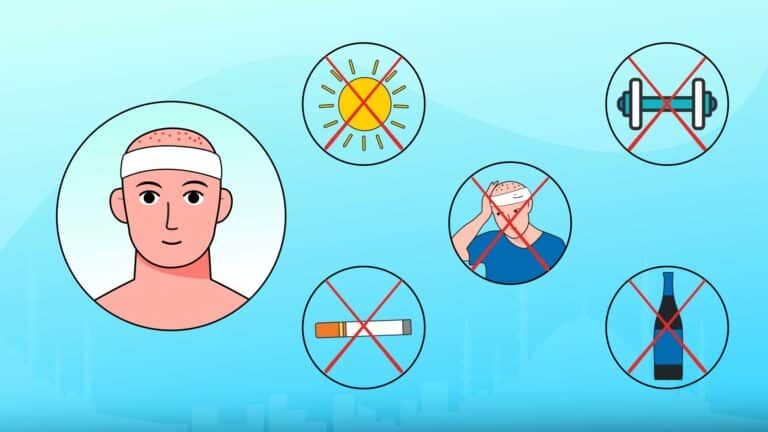
By Prof. Dr. Soner Tatlıdede · October 2026 Congratulations on completing your hair transplant. While the surgical part is finished, the success of your restoration now depends heavily on the recovery phase. In our clinical experience, the first two weeks post-surgery are just as critical as the procedure itself. Understanding what to avoid after a hair transplant […]
Scalp psoriasis and seborrheic dermatitis are chronic inflammatory conditions that frequently cause discomfort, itching, redness, and scaling. For individuals experiencing hair thinning alongside these conditions, severe anxiety often arises regarding permanent follicle loss and the feasibility of hair restoration. A central concern among patients is whether undergoing a hair transplant while managing scalp psoriasis is […]


Thank you!
Your details have been successfully submitted. Thanks!