


How Many Hair Grafts Do I Need? Medical Calculation & Density Guide
By Prof. Dr. Soner Tatlıdede · July 2026
Graft count and method interact: which technique suits your case is set out separately.
Quick Medical Takeaways
- Graft vs. Hair Strand: A graft (follicular unit) contains an average of 1 to 4 hairs. Therefore, 3,000 grafts yield approximately 6,000 to 7,500 individual hair strands.
- The Density Rule: Natural-looking hair coverage requires 35 to 50 grafts per square centimeter (grafts/cm²) in the recipient area.
- Donor Capacity Sets the Limit: There is no universal maximum. What can safely be transplanted in one session is whatever your donor area can give without leaving it thin, which is why we plan around max grafts for your donor area rather than selling a fixed number.
- Individualized Assessment: The exact required number depends on hair thickness, curliness, contrast between hair and scalp color, and donor area supply.
Comprehensive Clinical Graft Requirement Table (Norwood Scale)
| Norwood Baldness Stage | Clinical Description of Recipient Area | Estimated Area Size | Required Graft Range | Medical Goal & Clinical Recommendation |
| Stage 1 (Norwood I) | Normal hairline with no visible recession | Less than 10 cm² | No transplant needed | Preventive medical care & therapies (PRP/Minoxidil). |
| Stage 2 (Norwood II) | Slight hairline recession at temples (M-shape) | 15 – 25 cm² | 1,000 – 1,500 grafts | Conservative hairline restoration and framing. |
| Stage 3 (Norwood III) | Deep temporal recessions + early crown thinning | 30 – 50 cm² | 1,500 – 2,500 grafts | Restoring temple points & strengthening mid-scalp. |
| Stage 3 Vertex (Norwood III V) | Frontal recession combined with circular crown spot | 40 – 60 cm² | 2,000 – 3,000 grafts | Balanced distribution between hairline and vertex. |
| Stage 4 (Norwood IV) | Moderate frontal baldness & expanding crown area | 60 – 80 cm² | 2,500 – 3,500 grafts | Dense frontal restoration with moderate crown filling. |
| Stage 5 (Norwood V) | Advanced hair loss with a narrow separating bridge | 90 – 120 cm² | 3,500 – 4,500 grafts | Intensive single-session covering major bald areas. |
| Stage 6 (Norwood VI) | Severe baldness; bridge between front and crown lost | 130 – 160 cm² | 4,500 – 6,000 grafts | Requires two separate sessions (8–12 months apart). |
| Stage 7 (Norwood VII) | Extreme baldness; only a narrow donor horseshoe remains | 170+ cm² | 6,000+ grafts (Multi-stage) | Managing expectations; body hair grafts (BHT) considered. |
These ranges are what each stage typically needs for good coverage. What can actually be transplanted is set by what your donor area can safely provide, which is assessed before surgery; the two numbers are not always the same.
The Fundamental Equation of Hair Restoration
When deciding to undergo a hair transplant, the first and most vital question patients ask is: “How many hair grafts do I actually need to achieve a dense, completely natural result?”
At Clinicana Hair Transplant Center in Istanbul, we emphasize that hair transplantation is an intricate surgical and aesthetic balancing act.
It is not about harvesting the maximum number of grafts possible; rather, it is about harmonizing what the bald recipient area requires with what your donor area (the back and sides of the head) can safely donate without causing permanent thinning or visible scarring.
In this exhaustive medical guide, our surgical team breaks down the exact formulas used by leading hair restoration surgeons to calculate graft requirements, key anatomical factors, and the severe medical risks associated with commercial “mega-sessions.”
What is a Graft? Anatomy of the Follicular Unit
A common misconception among patients is confusing a “graft” with a “single hair strand”.
- The Graft (Follicular Unit): Is a naturally occurring anatomical structure in the scalp containing 1 to 4 hair follicles, complete with tiny blood vessels, nerve endings, and sebaceous glands.
- The Hair-to-Graft Ratio: In a healthy human scalp, the average ratio is 2.0 to 2.4 hairs per graft.
- For example, if a surgeon transplants 3,000 grafts, and your average ratio is 2.2 hairs/graft, you receive approximately 6,600 individual hairs.
- Strategic Anatomical Placement:
- Single-hair grafts (Singles): Exclusively transplanted along the leading row of the frontal hairline to create a soft, natural, feathered transition.
- Multi-hair grafts (Doubles & Triples): Implanted behind the hairline, mid-scalp, and crown to provide optical volume, density, and structural coverage.
The Density Formula: How Many Grafts Per Square Centimeter (cm²)?
Unprocessed natural scalp density ranges between 60 to 100 grafts/cm². However, the goal of surgical hair restoration is not to match 100% of original biological density, but rather to achieve the “Illusion of Density.”
- The 50% Visual Rule: Clinical studies demonstrate that the human eye cannot detect hair loss until the scalp loses more than 50% of its original native density.
- Target Surgical Density:
- Frontal Hairline & Mid-scalp: We aim for 40 to 50 grafts/cm² to deliver robust optical coverage and a youthful appearance.
- Crown / Vertex: We target 30 to 35 grafts/cm² to optimize graft conservation while concealing the scalp.
Practical Mathematical Calculation:
If an examination determines your frontal bald area measures 40 cm², and the target density is 40 grafts/cm²:
Required grafts = 40 cm² × 40 grafts/cm² = 1,600 grafts
Four Key Biological Factors Influencing Your Graft Count
Calculating graft requirements extends far beyond measuring surface area; it involves evaluating specific anatomical characteristics:
- Hair Shaft Thickness (Caliber): Coarse, thick hair provides significantly more optical volume than fine hair. A patient with thick hair may achieve excellent coverage with 2,500 grafts, whereas a patient with fine hair might require 3,500 grafts for an identical visual result.
- Hair Wave and Curl: Curly or wavy hair bends over the scalp surface, blocking light reflection and providing superior coverage per graft compared to straight hair.
- Hair-to-Scalp Color Contrast: Minimal contrast (e.g., blonde hair on fair skin or dark hair on dark skin) creates the appearance of higher density. High contrast (dark hair on pale skin) makes scalp exposure more noticeable, requiring precise density placement.
- Donor Area Capacity & Health: The safe donor zone contains roughly 12,000 to 15,000 total grafts. Over a lifetime, a surgeon should harvest no more than 30% to 35% of this reservoir (roughly 4,000 to 6,000 grafts total) to avoid compromising the donor zone’s aesthetic integrity.
Why the Crown Usually Needs More Grafts Than the Hairline
The hairline is a narrow band, and density there is what frames the face. The crown is a large circular area where hair grows in a spiral, so the same number of grafts covers it less densely, and light passing through the whorl makes thinning more visible. That is why many plans treat the front first and add the crown later, once the donor area is assessed. See crown hair transplant and the receding hairline stages.
How Your Graft Number Is Estimated
- Online pre-assessment: from photos of the front, sides, top, crown and donor area, the team gives an initial range and the most suitable technique.
- In-person donor examination: density, hair thickness and scalp laxity are measured with a dermoscope on the day of the consultation.
- Final plan: the number is confirmed only then, balancing the areas to cover today with the donor reserve you may need in the future.
There is no fixed graft cap and no number promised before this examination: the right figure is the one your donor area can safely provide for your goals. Read about the FUE donor area.
The Danger of Commercial “Mega-Sessions” and Promised Graft Numbers
Commercial clinics often sell a graft number in advance, sometimes 6,000 to 7,000 in a single day, before anyone has assessed the donor area. At Clinicana, following the guidelines of the International Society of Hair Restoration Surgery (ISHRS), we plan the opposite way round: the donor area decides the number. A figure promised before examination is a commercial claim, not a surgical plan, and chasing it carries real clinical risks:
- Donor Area Over-Harvesting: Harvesting extreme numbers leaves permanent patches, moth-eaten scarring, and irreversible thinning at the back of the head.
- Compromised Graft Survival Rate: Keeping extracted grafts outside the body for longer than 6 to 8 hours severely depletes their cellular energy and oxygen supply, leading to high graft mortality before implantation.
- Vascular Necrosis & Poor Blood Supply: Packing thousands of grafts densely into a traumatized scalp overwhelms localized vascularization, increasing the risk of scalp necrosis and complete surgical failure.
How we plan it: we transplant as many grafts as your donor area can safely provide in one session, assessed with trichoscopy before surgery. Where the area to be covered needs more than your donor area can safely give at once, such as advanced baldness (Norwood VI or VII), the work is split into two sessions spaced 8 to 12 months apart rather than forced into one day.
Surgical Techniques & Their Relation to Graft Quantity
| Surgical Technique | Recommended Graft Range | Key Clinical Features & Advantages |
| Sapphire FUE | 2,500 – 4,500 grafts | Ideal for large surface areas. Sapphire blades create micro-incisions that reduce tissue trauma and allow dense channel creation. |
| DHI (Direct Hair Implantation) | 1,500 – 3,000 grafts | Best for targeted high-density areas and transplanting between existing hairs without full shaving. Offers precise control over angle and depth. |
| Hybrid Technique (FUE + DHI) | 3,500 – 4,500 grafts | Combines DHI for delicate hairline creation with Sapphire FUE for maximum coverage across the mid-scalp and crown. |
If your scalp donor area cannot supply enough grafts, body hair can sometimes be transplanted to the head.
To put graft numbers in context, it helps to know how many hairs are on a human head and how that average changes with hair colour.
FAQs
Does a higher graft count always guarantee a denser result?
No. Density depends on graft survival rate, hair caliber, proper angle alignment, and artistic placement by an experienced surgeon—not merely on the raw number of harvested grafts. Our hair transplant cost guide explains what each graft range covers.
How is my donor area capacity evaluated prior to surgery?
During your clinical evaluation at Clinicana, our medical team utilizes digital trichoscopy (dermatoscopy) to measure follicular unit density per mm² and assess the proportion of multi-hair grafts available.
Can body hair be used if my head donor area is insufficient?
Yes. In cases of severe hair loss (Body Hair Transplant – BHT), beard hair grafts can be harvested from under the jawline to supplement density in the mid-scalp and crown.
Medical Disclaimer & Author Review
Medical Disclaimer: The calculations and ranges presented in this article serve as general educational estimates based on clinical literature. Individual requirements are determined solely following an in-person medical evaluation.
- Medical Review By: Prof. Dr. Soner Tatlıdede, Lead Plastic & Reconstructive Surgeon, ISHRS Member — Over 22 years of surgical experience and 18,947 successful procedures.
Academic & Clinical References:
- National Center for Biotechnology Information (NCBI): Graft Survival Rates and Mathematical Calculations in Follicular Unit Extraction (FUE).
- International Society of Hair Restoration Surgery (ISHRS): Global Practice Census Statistics & Guidelines on Safe Donor Extraction Limits.
- Journal of Cutaneous and Aesthetic Surgery: Donor Area Preservation Protocols in Modern Hair Restoration.


By Prof. Dr. Soner Tatlıdede · October 2026 When can you cut your hair after a hair transplant? Hair in the donor area can be trimmed after 1 month using scissors or clippers. As for the recipient area, trimming only the ends of the hair using scissors is permitted after 2 months. However, you must wait at […]
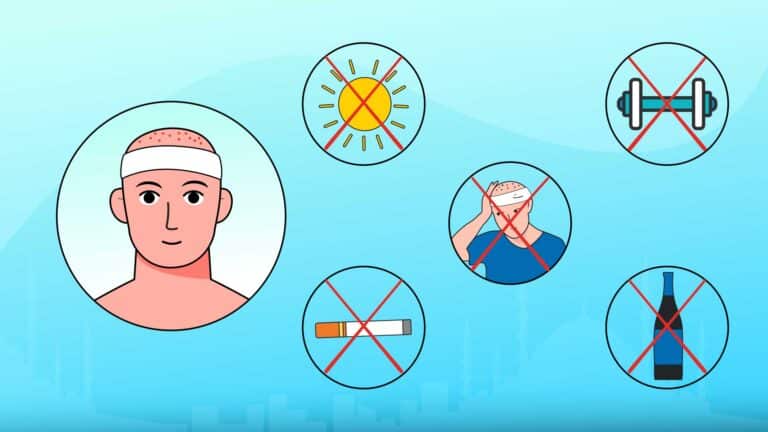
By Prof. Dr. Soner Tatlıdede · October 2026 Congratulations on completing your hair transplant. While the surgical part is finished, the success of your restoration now depends heavily on the recovery phase. In our clinical experience, the first two weeks post-surgery are just as critical as the procedure itself. Understanding what to avoid after a hair transplant […]
Scalp psoriasis and seborrheic dermatitis are chronic inflammatory conditions that frequently cause discomfort, itching, redness, and scaling. For individuals experiencing hair thinning alongside these conditions, severe anxiety often arises regarding permanent follicle loss and the feasibility of hair restoration. A central concern among patients is whether undergoing a hair transplant while managing scalp psoriasis is […]


Thank you!
Your details have been successfully submitted. Thanks!