


FUT hair transplant: results & recovery time
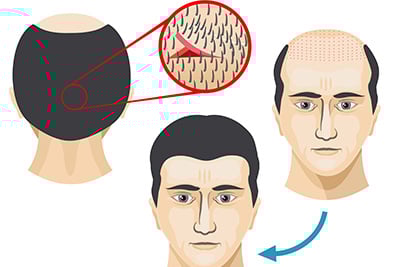
In a FUT hair transplant the follicles are transplanted using a method known as Follicular Unit Transplantation (where the acronym FUT comes from). Despite the fact that FUT hair transplant cost is lower compared to other techniques, it has lost its popularity with the progress of technology in hair transplantation operations, despite being still applied in some exceptional cases.
(h2) What is a FUT hair transplant?
There are 2 methods for hair transplant operations currently in use. The FUE (Follicular Unit Extraction) method and the FUT (Follicular Unit Transplantation) method. These two techniques differ in the way hair follicles are extracted from the donor area. The cost of a hair transplant in Turkey may vary if you use one method or the other, too.
The steps other than this issue are almost the same. In the FUT method, hair follicles are extracted by removing a strip of scalp of about 15-20 cm to 2 cm from the back of the head, between both ears. Then, hair follicles are harvested from the strip and individually transplanted to the recipient areas. The area where the strip of scalp was removed is closed with stitches.
Results & side effects
The FUT hair transplant results in an incision scar of about 15-20 centimetres in size, being this one of its main side effects. The recovery time is also longer, since an incision is performed on the scalp. Depending on the strain, the rate of wound healing, and the quality of the surgical procedure performed, this scar may expand and there may be hair loss around the scar.
Advantages of the Follicular Unit Transplantation
The main advantage of the FUT method – which is not a significant advantage – is that scalp is removed in a strip by an incision, so contrary to the FUE technique, it is not necessary to shave this area. Therefore, this method is preferred by women or men with long hair. Besides, another advantage is the shorter duration of the operation compared to the FUE method, where it can be several hours longer.
In summary, these are the main advantages:
- Operation is completed in a shorter time.
- Hair shaving is not required for the operation.
- It is a more suitable method for graft removal for patients with curly hair, especially in African hair type. However, the incision scar on nape might be remarkable in these patients because of their shorter hair.
Disadvantages of using the FUT technique
- A maximum of 2,000 grafts can be extracted, approximately. However, that number can range from 4,500 to 5,000 in the FUE technique.
- A scar remains on nape area after the operation. Surgical procedure and suture must be performed by a plastic surgeon.
- Since the area of removed scalp is damaged, numbness might occur after the operation.
- More bleeding occurs during the operation compared to the FUE method.
- The nape area is more painful after the operation.
- Despite the overall costs being lower than using the FUE technique (due to the long time required in the surgery), the cost per hair with FUE is often lower than using the FUT method.
FUE and FUT hair transplant: which one is better?
Despite being still used in some specific cases, in Turkey the FUT hair transplant is being taken over by the FUE method due to the many advantages of this one. Let´s see it in detail:
| FUT vs FUE Hair Transplant | |
| FUT Hair Transplant | FUE Hair Transplant |
| Hair follicles are extracted by removing a strip of scalp with an incision | Hair follicles are extracted with sub-millimeter punch without an incision |
| Recovery time is longer | Recovery time is shorter |
| 2,000 grafts can be extracted at maximum | Graft number can be increased up to 4,500-5,000 |
| Leaves scars after the operation | Doesn’t leave any scar |
| Surgery lasts for shorter time | Surgery lasts for longer time |
| More bleeding occurs during operation | Less bleeding occurs during operation |
| Hair shaving is not required | Complete hair shave is required |
| FUT hair transplant costs cost per hair are bigger | Hair transplant costs per hair are less compared to FUT |
FUT hair transplant: recovery time and scar
After getting a hair transplant with the FUT method, your head should be healed and free of scabs in 10 days after the surgery. New hair will start to grow in the treated areas after 4 months. Usually, your head will gain hair density during the first 10-15 months.
When a patient gets a FUT hair transplant, a scar is leaved after the operation; therefore, a revision of the scar may be necessary. The scar area on the scalp can be thinned again by a surgical procedure, and hair follicles can be transplanted to the scar area; however, sometimes scars can be concealed only by using micropigmentation, also referred as semi-permanent make-up or dermal-pigmentation.


Diagnostic Parameter Tinea Capitis Alopecia Areata Seborrheic Dermatitis Primary Etiology Dermatophyte fungal infection (Microsporum / Trichophyton) Autoimmune response targeting hair follicles Overgrowth of Malassezia yeast and inflammatory reaction Scalp Scaling Present (fine grayish scales or thick crusting) Absent (scalp is smooth and clinically normal) Present (greasy, yellowish, or diffuse white flakes) Hair Shaft Appearance Broken […]
Medical Review by: Prof. Dr. Soner Tatlıdede – September 2026 Quick Summary (TL;DR) Iron deficiency—specifically depleted serum ferritin stores—is one of the most prevalent nutritional triggers of diffuse hair shedding, particularly among women and vegetarians. Iron is not merely a component of blood cells; it serves as a critical biological catalyst for cellular division and oxygen transport inside […]
Medical Review by: Prof. Dr. Soner Tatlıdede – September 2026 Direct Definition: What Is Female Pattern Baldness? Female pattern baldness (androgenetic alopecia in women) is a genetically influenced condition characterized by progressive hair thinning across the vertex and widening of the central part line, while usually preserving the frontal hairline. Unlike male pattern hair loss, which frequently causes […]


Thank you!
Your details have been successfully submitted. Thanks!