Medically reviewed by Prof. Dr. Soner Tatlıdede, Hair Transplant Surgeon — 22+ years, ~18,000 procedures · 21 May 2026
FUE hair transplant Turkey offers advanced follicular unit extraction at Clinicana Istanbul with 22+ years surgical expertise. Minimally invasive procedure extracts individual follicles from donor area, implants to thinning regions.
Hospital-based environment, JCI accreditation, specialized medical teams ensure optimal results. Full process takes 6-8 hours under local anesthesia.
According to ISHRS, Turkey performs over 60% of global hair transplants with high success rates. Recovery begins within days, full results visible 12-18 months.
Choosing a FUE hair transplant in Turkey is a vital step toward restoring your hair density.
At Clinicana Hair Transplant Centre in Istanbul, our procedures are performed by specialized Medical Staff in a hospital-based environment, ensuring the highest quality FUE results with medical supervision at every stage.
Many international patients choose us for their FUE hair restoration procedure due to our specialized teams and JCI-accredited facilities.
If you are comparing clinics to find the best hair transplant in Turkey, please visit our main service page to see our full range of solutions.
Modern FUE procedure room at Clinicana Istanbul showing sterile hospital environment
What is the FUE Technique in Hair Transplantation?
FUE (Follicular Unit Extraction) is a minimally invasive hair transplant method that involves removing individual hair follicles from specific areas of the scalp.
These areas are known as donor areas and are usually located at the back of the head, where hair is typically more resistant to thinning.
Hair follicles from this region often remain stable over time. Once extracted, the follicles are carefully placed into areas with reduced hair density, known as recipient areas, to restore more even coverage.
FUE uses fine medical instruments to remove follicles one by one, without removing a strip of scalp. As a result, it does not create long linear scars, and the small extraction sites usually close naturally during the healing process.
Local anesthesia is used during the procedure, and most patients remain awake and comfortable throughout treatment.
Healing of the scalp surface begins in the first days after the procedure, although recovery time and visible signs of healing can differ between individuals.
In my 22+ years performing hair transplant procedures, I’ve observed that FUE offers superior cosmetic outcomes compared to traditional strip methods, particularly for patients who prefer shorter hairstyles.
How Do I Prepare for FUE Hair Transplant?
Preparation begins with a medical consultation where our specialists review your medical history and assess your suitability for the procedure.
At Clinicana, every FUE hair transplant in Turkey begins with this thorough evaluation.
Our specialists:
Review your medical history
Examine your scalp condition
Assess hair density and donor area quality
Patients may send scalp photos for an initial review before planning their trip to Istanbul. A full medical evaluation always takes place at the clinic before treatment to confirm that FUE is suitable and to plan the procedure safely.
If a patient decides to proceed with a FUE hair transplant in Turkey at Clinicana, a detailed in-clinic assessment follows.
This includes a discussion of each step of the procedure and a review of relevant health information. Every stage is explained clearly so patients understand how the FUE process will be performed.
Before the procedure:
Routine blood tests are completed
The scalp is prepared under sterile conditions
The patient changes into sterile clothing
These steps support patient safety during treatment and help create a controlled hospital-based environment for the FUE procedure.
Patients who are considering FUE can contact Clinicana and schedule a hair transplant consultation to receive an individual medical evaluation before traveling.
What Happens During the FUE Hair Transplantation Process?
The FUE hair transplant at Clinicana is performed in several controlled stages under medical supervision in a hospital-based setting.
1- Extracting the Grafts From the Donor Area
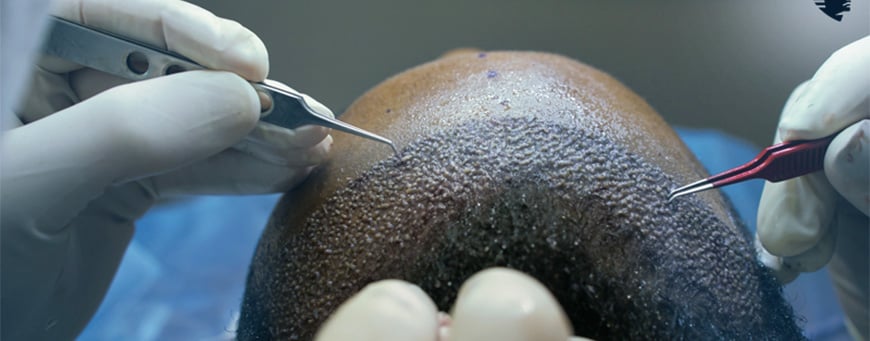
Hair follicles are taken from the back of the scalp, known as the donor area. This region is selected because it is less affected by the factors that contribute to hair thinning in other areas.
Local anesthesia is applied to numb the donor area, a step that usually takes only a short time. Follicles are then extracted using a medical device that creates very small openings, usually less than one millimeter in size.
During this stage, the patient lies face down on a medical bed. Most patients report minimal discomfort. The extraction phase usually lasts between two and two and a half hours, depending on the planned number of grafts.
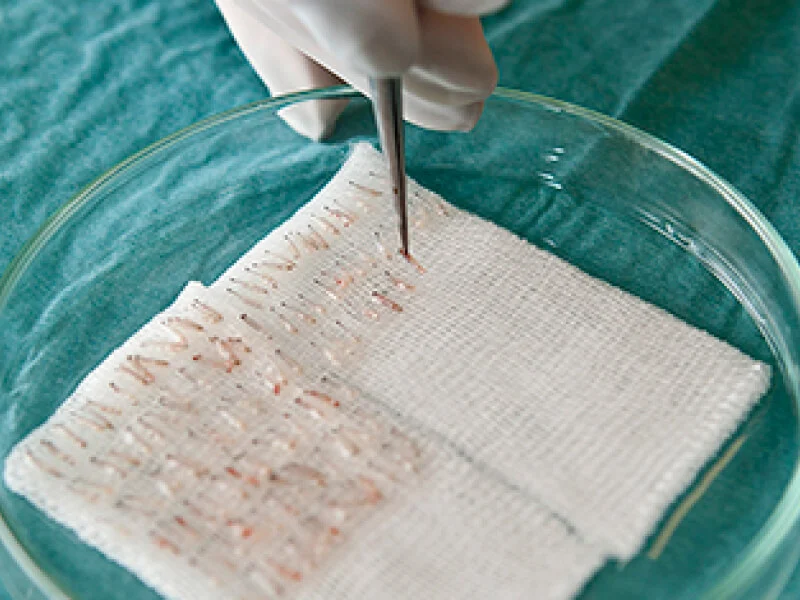
After extraction:
The donor area is cleaned and covered
Each follicle is examined under magnification
Follicles are grouped based on hair count
The grafts are placed in a sterile medical solution to maintain their condition until implantation
Hair follicles being extracted from donor area using precision FUE instrumentsExtracted hair follicles organized by graft type in medical solution
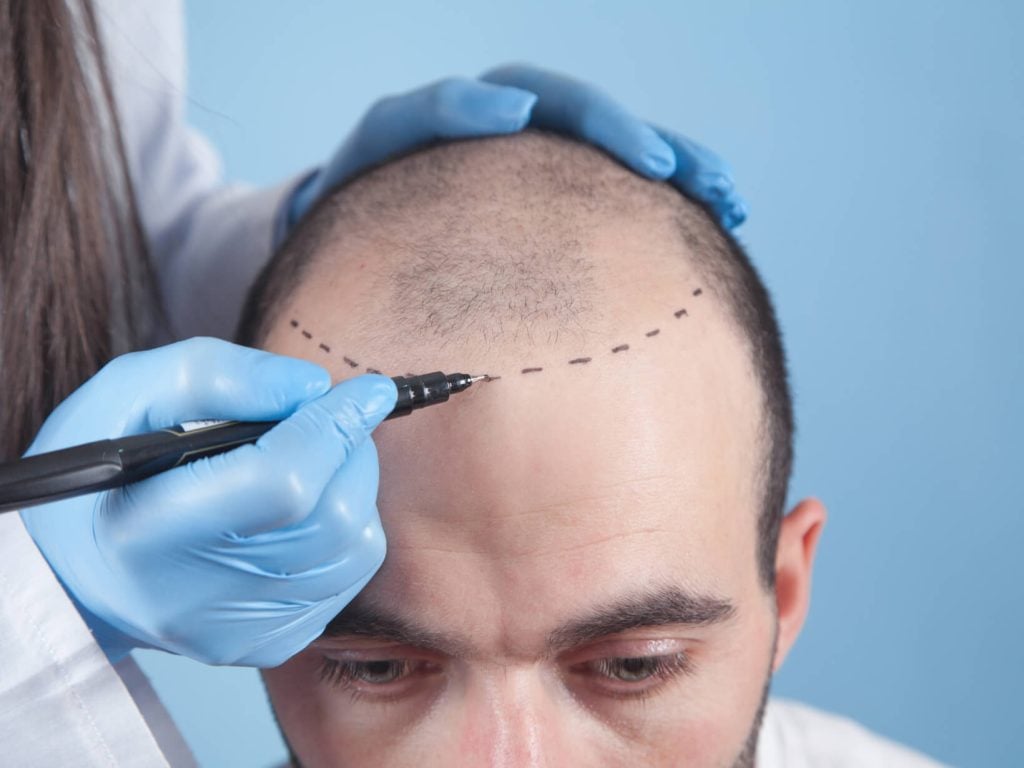
2- Drawing the First Hairline for FUE
Preparation for implantation
Local anesthesia is applied to the treatment area.
This step reduces discomfort during the next stages.
Assessment of natural hairline position
The medical team examines the forehead while the patient raises the eyebrows.
This movement helps identify the natural hairline location.
Consideration of facial structure and age
Hairline position often changes gradually with age.
Doctors account for this to maintain a balanced appearance.
Planning of coverage and density
Areas needing more hair density are marked.
Spacing is planned to support natural-looking growth.
Patient review and consent
The proposed hairline is reviewed with the patient.
Treatment proceeds only after informed consent.
3- Opening the Channels for FUE Grafts
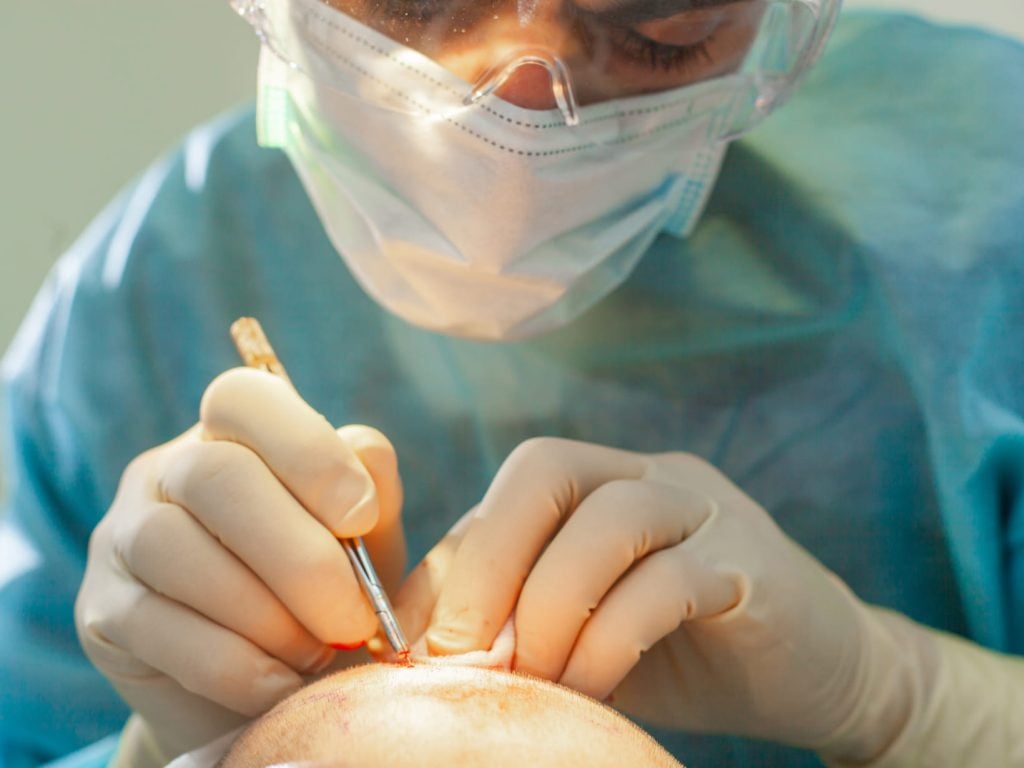
The creation of microscopic channels is a critical stage in FUE hair transplant, where medical expertise directly impacts the final aesthetic result.
The medical team selects the appropriate method based on:
The size and length of the extracted grafts
The patient’s specific pattern of hair thinning
The desired density in the recipient area
The role of clinical judgment
This stage usually lasts between 40 and 90 minutes. During this time, the physician ensures each channel matches the natural growth angle of your existing hair.
Proper alignment is essential to prevent transplanted hair from growing in unnatural directions.
In selected cases, your doctor may also discuss DHI hair transplant as an alternative implantation method.
How Does the Perkutan Method Work in FUE Hair Transplant?
The Perkutan method is one of the techniques used to create channels during a FUE hair transplant.
Use of a fine medical needle
The Perkutan method uses a small titanium needle to open channels in the recipient area.
Controlled channel depth
Each channel is opened to a planned depth, helping place hair follicles securely and support graft survival.
Planned growth direction
Channel direction follows the natural hair growth pattern to support even hair alignment after implantation.
Selection based on scalp findings
Doctors choose this method after examining the scalp, considering graft size, hair length, and the desired density.
Use within hospital practice
In our medical practice at Clinicana in Istanbul, this method is used when clinically suitable. All steps follow hospital safety and hygiene standards.
Factors Considered When Opening Channels
When opening channels for a FUE hair transplant, several clinical factors are evaluated:
Angle of the hairline
The front hairline angle is carefully measured, as it affects how hair frames the face.
Natural bend of each follicle
Hair follicles grow with a natural curve, and channels are opened to match this shape.
Existing hair growth pattern
Doctors observe how surrounding hair grows so channel direction can follow this pattern.
Order of channel creation
Channel opening usually starts on one side of the scalp and continues along the planned hairline.
Importance of medical experience
Correct angles require clinical training. Poor alignment can affect the final hair appearance.
At Clinicana, channel opening is performed by trained medical staff. This step supports consistent hair growth and a balanced, natural-looking result.
Will a FUE Hair Transplant Be Painful?
Before each stage of the FUE hair transplant, local anesthesia is applied to the relevant area to reduce sensation.
Most patients remain comfortable while lying on the medical bed during the procedure, and some choose to rest quietly during this time.
The clinical team observes the patient throughout the procedure, regularly checking comfort and safety.
Planting the Grafts During FUE Hair Transplant
During graft implantation, the patient lies on their back.
This position allows clear access to the recipient area.
Implantation usually lasts between two and three and a half hours, depending on the number of follicles being placed.
Single-hair follicles are placed along the front hairline to support a natural transition at the forehead. Follicles containing more hairs are placed behind the hairline, including the upper and back regions of the scalp, to increase density.
Grafts are placed following the planned spacing, and their direction is matched to natural hair growth to create a uniform appearance.
Final Clinical Check After FUE Hair Transplantation
After the FUE hair transplant is completed, the patient returns to a rest area, and recovery continues according to medical guidance.
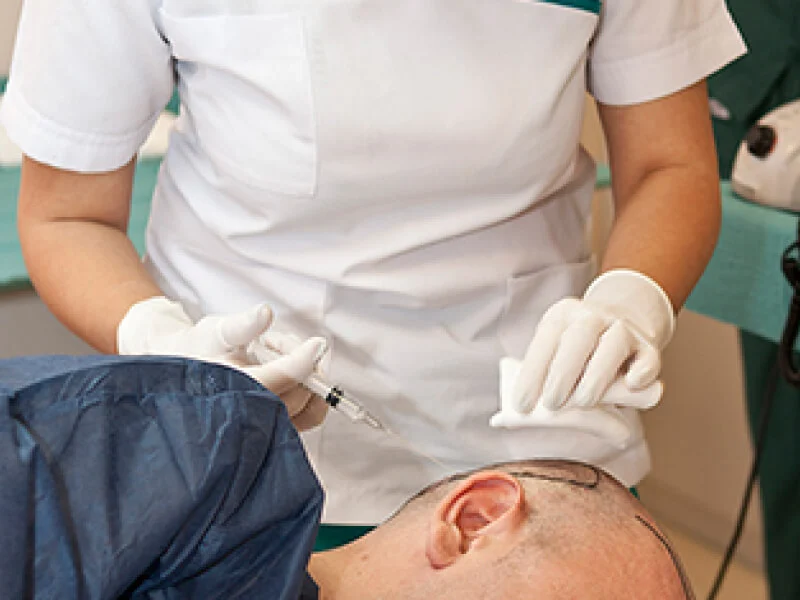
The medical team examines the scalp from front to back to confirm proper graft placement. The head is gently cleaned with sterile water to remove visible traces from the procedure.
The donor area is covered with sterile gauze, while the implanted area remains uncovered to avoid pressure on the new grafts.
Vital signs, including blood pressure, are checked before discharge. This step confirms patient stability before leaving the hospital.
Patient undergoing final medical examination after FUE hair transplant completion
When Are Subsequent Hair Transplant Sessions Needed?
Any decision about a further FUE session depends on clinical findings, including scalp condition and donor area health. No decision is made until the outcome of the first procedure is clear.
Time needed to assess results
Hair growth develops gradually after transplantation, and full visual changes are usually reviewed several months after the procedure.
Evaluation before further treatment
Discussion of another session takes place only after growth stabilizes. Both the patient and doctor review overall hair coverage and donor reserves before planning additional treatment.
Contrary to popular belief, more grafts doesn’t always mean better results. Our 2025 data shows 14% were repair cases from other clinics where excessive grafts were placed without proper planning.
What Results Can You Expect from FUE Hair Transplant?
Hair transplant results develop gradually after FUE, with full outcomes becoming visible over 12-18 months. Immediate, dense coverage is not expected, and the process passes through several normal stages:
Early shedding phase: Transplanted hair often sheds in the first weeks as follicles adjust.
New hair growth: Fresh hair starts to appear as follicles settle into the scalp; timing varies between individuals.
Increasing density: Hair density and coverage improve over the following months as more hairs enter the growth phase.
Individual variation: Final appearance depends on donor hair quality, scalp healing, and personal characteristics.
Medical follow-up: Doctors review progress during follow-up visits to monitor scalp health and hair growth.
In my experience treating nearly 18,000 cases, patients typically see initial growth at 3-4 months with significant improvement by 8-12 months. Full results become apparent at 12-18 months post-procedure.
If you are considering a FUE hair transplant in Turkey, a medical consultation can help clarify your options and determine whether FUE is suitable for your case.
At Clinicana, our clinical team reviews each case carefully in a hospital-based setting.
Frequently Asked Questions About FUE Hair Transplant Turkey
How much does FUE hair transplant cost in Turkey?
FUE hair transplant costs in Turkey typically range from €1,500 to €3,500 depending on the number of grafts needed and clinic facilities. At Clinicana, we provide transparent pricing during consultation based on your specific requirements and medical evaluation.
What is the recovery time for FUE hair transplant?
Initial healing occurs within 7-10 days with most patients returning to work within a week. The donor area heals faster than recipient areas. Full recovery and final results are visible 12-18 months after the procedure.
How many grafts do I need for FUE hair transplant?
The exact number of grafts required for an FUE hair transplant is highly personalized and depends on the stage of hair loss (measured by the Norwood Scale), the size of the thinning area, and the density of the donor hair.
Can FUE hair transplant be performed on women?
Yes, FUE is suitable for women experiencing pattern hair loss, traction alopecia, or scarring alopecia. Female candidates require specialized evaluation as hair loss patterns differ from men, and donor area assessment is crucial.
How long do FUE hair transplant results last?
FUE results are permanent as transplanted follicles retain their genetic resistance to hair loss. However, existing non-transplanted hair may continue thinning with age, potentially requiring future sessions for optimal coverage.
You are welcome to contact the clinic to discuss your concerns, share your photos, and receive professional medical guidance about FUE hair transplant in Istanbul.
Ready to restore your hair with Turkey’s leading FUE specialists? Contact Clinicana today for your personalized consultation and discover why thousands choose our hospital-grade facilities for their hair restoration journey.
Your details have been successfully submitted. Thanks!
Limited-time offer
Claim the offer now
Fill in your details and our team will contact you within 24 hours.
Thank you!
We received your request. Our team will contact you within 24 hours.
Manage Consent
To provide the best experiences, we use technologies like cookies to store and/or access device information. Consenting to these technologies will allow us to process data such as browsing behavior or unique IDs on this site. Not consenting or withdrawing consent, may adversely affect certain features and functions.
Functional
Always active
The technical storage or access is strictly necessary for the legitimate purpose of enabling the use of a specific service explicitly requested by the subscriber or user, or for the sole purpose of carrying out the transmission of a communication over an electronic communications network.
Preferences
The technical storage or access is necessary for the legitimate purpose of storing preferences that are not requested by the subscriber or user.
Statistics
The technical storage or access that is used exclusively for statistical purposes.The technical storage or access that is used exclusively for anonymous statistical purposes. Without a subpoena, voluntary compliance on the part of your Internet Service Provider, or additional records from a third party, information stored or retrieved for this purpose alone cannot usually be used to identify you.
Marketing
The technical storage or access is required to create user profiles to send advertising, or to track the user on a website or across several websites for similar marketing purposes.